 |
 |
 |
 |


|
|
|

|
Verity
|
 |
|
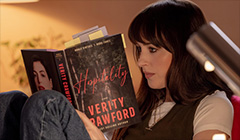
I am a sucker for any psychological thriller about duelling writers – variants for one writer versus scheming agent, twisted assistant or sociopathic fan duly allowed – but Verity is the veritable pits. The set-up in this instance: morose, perhaps disturbed, ‘serious’ young rookie novelist Lowen (Dakota Johnson) is hired (by publisher Hachette, no less) – under a strict Non-Disclosure Agreement! – to help out popular writer Verity (Anne Hathaway) in the composition of the latest book in her best-selling series. Why Lowen is judged to be the best bet for this strictly by-the-genre job is never satisfyingly explained, beyond some minor diversion involving Jeremy (Josh Hartnett), Verity’s husband, having read and liked Lowen’s modestly successful literary effort. Surely Artificial Intelligence could whip up such a formulaic book much faster and cheaper? If that was so, then there would be no ‘triangular’ plot brewing. But Verity has real problems finding – or rather, defining and refining – its plot. And this despite a script by tele-veteran Nick Antosca (A Friend of the Family, 2022) – although, come to think of it, his over-inflated Cape Fear series adaptation (2026) also displayed a tendency to wander all over the possibility-map with no clear or overriding purpose. The situation here is not like, say, Roman Polanski’s Based on a True Story (2017) in which the superior writer passes in and out of active or conscious states. Nor is it firmly pinned to the ‘class difference’ of ‘pop’ versus ‘quality’ literature, as such stories in the Misery mode (as well as the extravagant SF variant pedalled by the Pluribus [2025- ] series) usually do. This is largely because Verity (the character) is completely catatonic and confined to a wheelchair (which doesn’t give Hathaway much to do, star-wise), due to a car accident that occurred in the aftermath of her young daughter’s death by drowning. (I won’t give anything away as the film is still quite recent, but, after viewing it, I still find it hard to fully re-establish the flimsy logic of its plot-and-psychology links.) Lowen spends time living in the same house as this gruesome family, going through all of Verity’s notes for the unfinished book – something that is pretty tough to make cinematically exciting (cue the usual flip-pad montage sequences). Even more tellingly in narrative craft terms, though, there’s the script problem that arises once Lowen chances upon Verity’s ‘secret autobiography’ hidden on a USB. If she reads this juicy document (printed out) all in one go (and who wouldn’t?), the narrative would lose a large chunk of its unfolding development. So we get that direly transparent ‘delaying tactic’ – I write about it elsewhere on this website in regards to the 13 Reasons Why series (2017-2020) – whereby Lowen starts reading Verity’s confession (duly and dully ‘illustrated’ in flashbacks and other tricks), only to throw it in the bin (never emptied!) half way through the page pile … and then, amazingly, fish it out later in order to get to the most shocking revelation! In a thriller, red herrings – like here, the nursemaid forever firing steely looks at Lowen – are one thing. Lurching in every thematic direction, and then letting those traces disappear at a whim, is, however, quite another. So, there is an entire intrigue based around the presumably traumatised, surviving twin (Crew played by Brady Wagner) of the dead daughter, which is hard to buy. Not to mention the Max Ophüls-like ‘woman’s melodrama’ of Lowen’s budding/imprisoning relationship with Jeremy – which may or may not be meant to mirror the same problems in the Verity/Jeremy union. Above all, there is the slathered-on nonsense about Truth (‘Verity’, get it?) and Fiction. Early on, the Big Question surrounding Verity’s phenomenally successful creativity is: how did she manage to access the immense, malevolent villainy that is placed in the narrational driving-seat of her novels? Is it her true, inner self? Later, we are allowed privy into a special writing technique Verity uses, known as ‘antagonistic journaling’ (if it didn’t exist in the real world a couple of months ago, Verity seems to have brought it into being, thank you Reddit!) – basically, making an extravagant fiction of oneself, in the darkest way possible. Just to know how a bad person really feels! By the end of the film, we have this document, we have another hidden letter written in Verity’s hand, we have shifty Jeremy at the helm of a car and silent, conspiring Crew in the back seat … and, if the point wasn’t crystal-clear already, it’s capped off with a TV talk-show clip in which Verity declares that she wanted to push ‘belief’ so far in order to capture the reader’s certainty … and then turn the tables and make them question the very category of certainty. Fritz Lang’s You Only Live Once (1937), it ain’t. Perhaps all this critique adds up to the simple complaint that Verity is dreadfully ‘televisual’. In the hands of director Michael Showalter (this is his 9th feature!), it’s TV all the way down, from the soaring drone shots of a verdant landscape to the paltry ‘jump scares’ and other flashy inserts. There is nothing enjoyable, positive or interesting about this film, adapted from a (mildly reflexive?) best-seller by Colleen Hoover that I will never read. I somehow doubt that – unlike Delphine de Vigan’s pretentious source novel for Based on a True Story – it includes erudite discussion of the narratological theories of Barthes, Genette, the regime of fiction and ‘truth effects’. Amazon MGM Studios just wouldn’t go for that. © Adrian Martin 28 October 2026 |


