 |
 |
 |
 |


|
|
|

|
Based on a True Story
|
 |
|
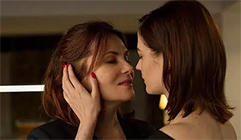
Even some diehard fans of Roman Polanski draw a blank when this film is mentioned – they’ve never heard of it. Before the relative international triumph of J’accuse (aka An Officer and a Spy, 2019) and what can be taken as the final, fuck-you gesture of his outrageous, little-seen comedy The Palace (2023), Polanski (now 93) leapt upon the sudden possibility of making Based on a True Story between one Cannes film festival and the next (where it premiered to scant acclaim or attention in 2017). The closeness of those dates also created the need for an urgent script collaborator: Olivier Assayas, whose Personal Shopper, resonant with this project, Polanski probably saw in Cannes 2016. (There is a useful academic piece by Żaneta Jamrozik in a 2023 issue of Studies in Eastern European Cinema that compares the two films.) Based on a True Story fascinated me when I first saw it (on a Spanish-release DVD): it goes without saying that it’s keenly directed from moment to moment (Polanski never disappoints on that score), well acted by Emmanuelle Seigner (for once not cast in a glamorous part) and Eva Green (creepy as all get-out, with spooky eyes that sometimes resemble an AI-generated animation); and pleasantly evocative, at moments, of the director’s Greatest Hits: Repulsion (1965), Rosemary’s Baby (1968) and especially The Tenant (1976). It is punctuated by two brief but striking dream sequences (Polanski has always been good at these), the surreal side of which is enhanced by judicious use of digital effects. On a second viewing, it’s not quite as impressive: one is likely to appreciate better the subtler moves of its tricky narrative mechanism, but there doesn’t seem much more to dig into. (Frantic [1988], by contrast, is a film I can return to forever.) Ariel Schweitzer announced the verdict plainly enough in his capsule review for Cahiers du cinéma (no. 738, November 2017, p. 63): “Reality and fiction, the abduction of identity, relations of power and domination, vampirisation, the slide toward madness … all such Polanskian themes can justify the recourse to a story as slight as this one, if only the film could transcend that material and trigger a truly personal work”. Intriguingly, Assayas describes the scriptwriting process as “helping Roman Polanski to be Roman Polanski” – as if there were some doubt over whether that could be achieved within the hasty production schedule. Based on a True Story is derived from a 2015 bestseller by Delphine de Vigan. I skimmed the 2017 English translation when I first saw the film, instantly forgot it altogether, and have now dutifully re-read it properly for the sake of this review! The novel is an odd mishmash of things: hyperconscious nods to popular fiction both literary and filmic (quotations from Stephen King’s novels Misery and The Dark Half included) alternate with earnest dialogues about textual realism and authenticity as imbibed by the characters in their ancient classes devoted to Barthes and Genette (!). It’s a terribly overextended, repetitive novel with too many erudite digressions, and weighed down with an endless, portentous litany of “Only later did I suspect …” statements – and, at least, Polanski and Assayas have done a decent job of streamlining it (without, mercifully, the narrational hindsight portents) into a sensibly driving plot economy. What they lose by doing so – and I’m not unhappy about this – is the class-based condescension that seems to haunt King and de Vigan alike: popular culture is the root of all (phantasms of) evil! Polanski’s disinterest in this theme is characteristic of his approach: as Pascal Kané noted back in 1969, the “most astonishing” feature of his art is “the seriousness with which he treats rather naive, dusty old genres”, without the (often obligatory) notes of camp or condescension. I sense, too, that the filmmakers were not keen to exploit the (grossly) intertextual links to Single White Female (1992) and the like; and that this orientation led them to jettison a key plot revelation at the very end of the novel, involving passages conspicuously copied, Purloined Letter-style, from an always-nearby shelf of books. Intriguing Polanski paradox: he proudly refers to Based on a True Story as effectively the last in a trilogy (after The Ninth Gate [1999] and the superb The Ghost Writer [2010]) about literal book manuscripts – and within a career post Cul-de-Sac (1966) overwhelmingly derived from literary and theatrical adaptations – but he avoids, like the plague, all the potentially fussy detail in those three films about ‘literary textuality’: not nearly cinematic enough for this purist! Assayas has hinted at the difficulties facing the screen adaptation of this hot property by de Vigan – cheekily adding that he considers his fast first draft to be better than the solution Polanski ultimately settled on. In many respects, though, the book-to-film transfer is expertly done: the director speaks of his eternal desire to capture not only the plot and characters of anything he adapts (as he likes to note, all the way from the heights of Shakespeare and Dickens down to quasi-pulp genre fiction), but also its shape, its density of detail. Schweitzer faults the film for its “broadly drawn” characters, but in fact much of de Vigan’s description of their traits finds expression in the scripting, costuming and acting. The book and film are equally stereotypical or figural on that level, and none the worse for it. The central reality/fiction frisson of de Vigan’s original premise – that it appears or pretends to be the chronicle of the author’s own experience (like, in 2026, Rachel Cusk’s similarly twisty conceit Life of M) after the success of her autobiographical tell-all Rien ne s'oppose à la nuit (2011, translated in 2014 as Nothing Holds Back the Night), rendered in the film (glancingly during the opening scene) as Vienne la nuit – is, of necessity, completely lost in the screen version. For that, Polanski would have had to make a film about himself! Of that possibility, we have only the faint trace of Polanski ‘signing’ his name onto the mostly white title page of the newly produced novel launched in the final scene – but that’s merely a flourish. (The most nakedly ‘personal’, albeit allegorical, late-style inscription of Polanski-as-auteur is surely the monstrously indelible, ultimate shot of The Palace. See it and you’ll never forget it!) I’ve only alluded so far to the basic plot material of the film. (it will be interesting to compare with the 2026 release Verity, which appears broadly similar.) Delphine (Seigner) is a writer facing a massive block, which is partly prompted by the menacing, anonymous letters she is receiving (seemingly from a member of her own family). A fan (Green) steps into her life, offering first friendship, and then elaborate assistance … to the point of moving in and living with her, and even taking her place (in disguise) at a public event (off-screen since, like the book but less insistently, the film is mainly filtered through Delphine’s viewpoint). This character’s name, by the way, is the victim of multiple crossed linguistic wires: she’s “Her [elle] as in Hermione” according to the film’s English subtitles, which, in the French, is Elle for Élisabeth – in the novel, shortened to plain L. – and, in the Spanish language dub, Ella as in Isabella! Go figure; I’ll stick with Elle. All up, it’s intimacy thriller meets Female Gothic material – Polanski is a past master, and even prime inventor of that mixed-form in cinema – and the film is at its trembling best whenever it plays on clinches of too-physical proximity or unexpected glimpses of sensuality, such as Elle’s sheerly stockinged legs arranged languorously on the floor. (There is more queer thrill of this kind in the film than in the novel, where – for some strange reason – it is explicitly ruled out as an element.) Gradually, signs of mental and emotional disturbance in Elle – such as her wild destruction of a recalcitrant fruit blender – begin to show. What’s her game? And, more importantly, what is the film’s game? Based on a True Story essentially follows two tracks simultaneously (and the ingenuity of this dispositif certainly requires a second viewing): either Elle is on a malign, vampiric quest to absorb Delphine’s identity and literally her work, and then cancel her existence (this is where the Misery-style intrigue enters, stoked by Alexandre Desplat’s ‘procedural’, tick-tick music score)); or, the writer is increasingly consumed by a schizophrenic fugue state, projecting her double/nemesis … perhaps for the purpose, precisely, of being able to invent a new fiction. (Like in Cronenberg’s adaptation of Burroughs’ Naked Lunch [1991], a finished manuscript appears seemingly out of nowhere: in this case, either authored by another, or conjured in a manic, mental fog.) The ace card in Polanski’s mise en scène arrangement of this double-intrigue: no other character (husband, neighbour, friend, accuser) is ever right there to witness Elle together with Delphine … and even in seemingly public places (such as a café) nobody speaks to or even looks at Elle. Beyond a certain point, this mind-game logic gets fuzzy – but that indistinctness between the real and the imagined is precisely what Polanski aims for, and gets. And so? Kané’s auteur-structuralist 1970 book on Polanski noted (already!) the sometimes “superficial manner” in which Polanski regularly plays what he calls the double reading game, in which “two terms” never cease bouncing off each other: “innocence and perversion (Repulsion), irony and tragedy (Cul-de-Sac), sensitivity and intelligence (Knife in the Water [1962]), work on plasticity and narrative construction (The Fearless Vampire Killers [1967]), emotional surface and interpretive depth (Rosemary’s Baby)” (Roman Polanski, Éditions du Cerf, pp. 50 & 52). In the case of Based on a True Story, there is something mechanical and rote about this alternation between the reading-levels of reality and fantasy, a bait-and-switch game that doesn’t manage to conclude in a satisfyingly enigmatic or open way (the novel works better in this regard) – as Rosemary’s Baby most certainly did. Still … why didn’t anybody (as far as I’m aware) rush to the brave defence of Based on a True Story in 2017? Here, I suspect, is one factor at play (beyond everything obvious to do with the director’s public notoriety): Polanski has, for a long time now, at least since Pirates in 1986, adopted a thoroughly ‘professional’ – to the point of seeming old-fashioned – mode of filmmaking. He rallies his faithful team of regular key collaborators: Desplat, DOP Paweł Edelman, editor Margot Meynier among them. All interiors are meticulously controlled sets; all scenes of motion – in a car, on a ship (as in the underrated Bitter Moon [1992]) – are mocked up in a studio. Nothing off-the-cuff, or even pretending to be spontaneous; little to no handheld camerawork – as if in permanent disgust at the pervasive looseness of the Nouvelle Vague legacy, so many years later. And it’s not as if Polanski is celebrating, in retro or postmodern fashion, ‘screenic artificialism’ (I borrow both words from separate texts by Philip Brophy!): there are no shoddy or obvious back projections, à la late Hitchcock, anywhere in his work. He aims for a good, solid illusion and is publicly glad when he succeeds at conjuring it. I respect the filmmaker’s wishes in this regard, but the style does exude a certain (shall we say) quaintness – or, to put it more kindly, an untimeliness in relation to wherever cinema is (supposedly) going these days. Does Based on a True Story, as Schweitzer suggests, present a “huis clos which is not truly oppressive”? In comparison with Polanski’s earlier classics, or with the current movies of the Safdie brothers and Gaspar Noé, that’s probably the case. But is it accurate to conclude (with Schweitzer) that the film “evaporates the moment it’s over”? Not exactly, in my opinion; I, at least, was compelled to revisit it! But it is a larger question than simply the efficacy (or otherwise) of this one, particular film; the special (sometimes peculiar, in all senses) mode of address of Polanski’s work may yet be eluding us. In his initial 1969 Cahiers review of Rosemary’s Baby (the piece is misdated at 1980 in the excellent 2015 essay collection Savoir dire pour vouloir faire, Yellow Now), Kané arrived at the point of arguing that even if, ultimately in the double-reading game, “Polanski opts for a cinema of fascination, it is nonetheless beyond fascination that he situates himself – and also beyond modern cinema’s ideals of reciprocity and exchange” (p. 87 in the reprint). In other words: neither the simple immersion of ‘thrilling entertainment’ nor the standard distanciation or dialogism of modernism. I suspect that the Polanski œuvre, in any of its states or phases, still has a lot to teach us. MORE Polanski: Chinatown, Death and the Maiden, The Fat and the Lean, The Pianist, Tess, Two Men and a Wardrobe © Adrian Martin 27 September 2026 |


