 |
 |
 |
 |


|
|
|

|
Where the Sidewalk Ends
|
 |
|
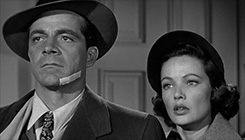
Several Otto Preminger masterpieces of the 1940s and ‘50s have only an oblique relation to the bouquet of ‘tropes’ (terrible modern word!) we retroactively associate with the film noir genre. His assumed Viennese ‘expressionism’ is very muted; his approach, paradoxically, concentrates on sunlight and daytime, exactly where we expect shadow and night. Where the Sidewalk Ends, however, sits right at the centre of noir history; it’s profoundly nocturnal in so many senses and ways. The project – for which Preminger was his own producer – doubtless began as an attempt to revisit the immense success of Laura (1944), via the casting of Dana Andrews and Gene Tierney. But everything has been reversed, as in a photographic negative: glamour is replaced by squalor; star power is exploited in extremely controlled doses; lyrical romanticism (for instance, in Cyril Mockridge’s fairly conventional music score, juiced up by the insertion of Alfred Newman’s familiar “Street Scene” theme) is largely absent; neurosis and even psychosis rule the day. And there’s an ending that affirms correct morality – but you find yourself wishing that the film could have taken the option (easily possible within the plot circumstances, if not within Hollywood’s ethical code) of evading it. Our main character ends up with the promise of “every chance in the world” … but how many such promises of redemption are there, really, in the noir universe? Jean-Pierre Coursodon wrote in his American Directors project that Preminger’s supposedly noir films “explore the neurotic fringes of passion in a tense, confined world where passion is always excessive, disruptive, and ultimately destructive”. The central passion of Mark Dixon (Andrews) in Where the Sidewalk Ends is not erotic attachment but obsession – he’s gripped by a complex drive, semi-lawful and semi-resentful. The emotional premise of Preminger’s films is a bleak proposition: obsessive passion, in its very essence, contradicts society, tears down civilisation. His protagonists are driven, and they are haunted by past traumas – even as the narratives, in general, eschew any recourse to flashback. Stéphane du Mesnildot (in a fine 2005 essay on Preminger’s noirs in Cinéma no. 10) dubs Dixon not a somnambulist (sleepwalker) but a vigilambulist: he enters the sphere of dreams awake, with his eyes wide open – an especially chilling state. Dixon is a pre-Dirty Harry figure – thus signalling something new in the post-World War II landscape of American film – in that he is compelled to step outside the law (i.e., step off ‘where the sidewalk ends’, beyond its limit) in order to individualistically uphold that law. In short – and as his superiors scold him – he enjoys sadistically beating up the bad guys. And there’s literally, in this story, only a small, steel plate separating a good bashing from an inadvertent killing. (On many counts, the film makes for a great double-bill with Nicholas Ray’s contemporaneous On Dangerous Ground [1951].) Once that ‘inciting incident’ has kicked the plot motor running, we enter into a fascinating alignment with this unlovely character of Mark: for most of the film, only we are privileged to know what he secretly knows, and we follow the ‘procedural’ steps of his cover-up in elaborate detail, over a ten-minute sequence that wields a (comparative) real-time effect. ‘Identification’ with a hero/anti-hero has rarely been so tricky or complex. Time is of the essence on so many levels in Where the Sidewalk Ends: experiences of luck, coincidence, missed encounter … lived time, remembered time … and, in cinema terms, suspenseful time and elided time. On this plane, we must salute the brilliant script by Ben Hecht, and acknowledge the significant transition in filmmaking style that he helped pioneer here and earlier in Alfred Hitchcock’s Notorious (1946): the extended, unified scene as defined by theatre gives way, at last, to the varied sequence that articulates often short vignettes in a coming-and-going, repetition-variation pattern. This pattern then extends to a large-scale systems of rhymes, echoes, and free displacements: such as when Thomas (Karl Malden), the ultra-rational cop, is advised to conduct a particular interrogation just as Dixon would – to bash his suspect! Three narrative structures are, in fact, ingeniously overlaid by Hecht and Preminger: a traditional three-act format, with the first and third parts relatively short, and a protracted middle; the addition of a climactic, mid-point turning-point; and, on top of those, a series of beautifully marked day/night transitions (Mark, this vigilambulist, rarely sleeps!). There’s nothing rigid in this overlay; it’s precisely the uneven interplay between them that produces the film’s ledger of variety and surprise – its living respiration. A similar analysis can be extended to Preminger’s astonishing mise en scène. Fans of the director (especially in the English-language, with the notable exception of Chris Fujiwara) have tended to fetishise the extended long take as his authorial trademark. The real key to his overall style, however, is in the careful concatenation of elaborate, highly mobile group shots and shot/reverse shot clinches – with ultra-close-ups (constituting the most expressionistic moments in terms of lighting) strictly reserved for special dramatic highpoints. Preminger, above all, modulates his effects. A master of reframing amidst rooms crowded with characters, Preminger plots the expressive movements of his figures in a veritable (and endlessly varied) ballet of sitting, standing, leaning, slouching, crouching, rising, falling … with spatial symmetries and dissymmetries providing well-plotted out cues for sharp cutting (by Preminger’s longtime editor Louis Loeffler). Meanwhile, each major actor is given a repertoire of specific gestures and postures to work with; special mention must be made here of Gary Merrill as the crypto-gay Scalise, punctually sniffing his asthma inhaler and fixing his neck (and therefore his side-gaze) at askew angles. He must have needed a good massage (we see Scalisi in one such ‘parlour’) after this shoot. No less inventive, at another rung of the mise en scène, is the attention to the low-life sets – “antechambers of Hell” according to du Mesnildot – and the remarkable penultimate location of a multi-storey building with car-elevator, which provides games of the seen and unseen (and allows Preminger to sidestep a final, conventional shootout-confrontation). Du Mesnildot notes that hints of the “supernatural” (such as the Golem-like apparition of a spatially-foreshortened, shrunken corpse in a closet) are “born not from a twisting of the real, but from the multiplication of frames that hollow out interior spaces within the visible: doors, windows, mirrors and pictures”. There are many examples of this here. Thematically, Where the Sidewalk Ends – what a great title, its moral-ethical metaphor handily illustrated for us in the opening, stylish credits – offers a complicated pattern (akin to Fritz Lang’s thrillers of the 1940s and ‘50s) of mirrors, doubles, rhymes, reversals … with a special attention to the possibilities of multi-layered irony. Much of this material refers to the family unit: where Dixon’s late father (as Scalisi well remembers) has left the original sin of criminal complicity on his soul, Morgan (Tierney) must fight to affirm the innocence of her good-guy Dad, Jiggs (Tom Taylor) – and he, too, shares a past connection with Mark. It’s only three decades or so later – in films by André Téchiné or Claire Denis – that we again find such an intricately knotted-up map of character relationships, often subterranean but crucial. Gérard Legrand once suggested that Preminger “makes opaque situations transparent … and transforms transparency into an obscurity that has no name” – as fine a melding of mise en scène and philosophy as can be imagined. French film criticism is (as it happens) particularly rich in its appreciations of Preminger, across five decades: to those I’ve cited so far, I add the names of Bertrand Tavernier and Jacques Lourcelles, as well as the superb website (2013/2014) by Olivier Eyquem and Despina Veneti, “Preminger Films Noirs”. Let the last word go to Michèle Weinberger: “Where the Sidewalk Ends is a film that gives the measure of the disenchantment of an era. In this chilling film, Preminger creates with perfect precision characters hounded by their need for a truth that is forever illusory.”
MORE Preminger: Anatomy of a Murder © Adrian MartinJuly 2015 |


