 |
 |
 |
 |


|
|
|

|
Wetherby
|
 |
|
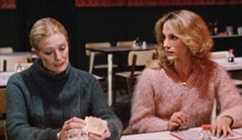
In the moody universe of writer-director David Hare, men are explicitly valorised for their passionate, existential acts – such as walking into a total stranger’s life and then committing suicide right in front of them – while women are implicitly faulted for their inability to “open up” (!) to such irascibly lovable and doubtless ‘driven’ violators. Vanessa Redgrave as Jean, reflecting back on her passionless, repressed/repressive life, and Joely Richardson (Vanessa’s real-life daughter) as Jean’s younger self, certainly give superb performances here – despite the general, overbearing air of arthouse misogyny so typical of Hare. Also on the plus side, the narrative is ingeniously constructed in mosaic-flashbacks beginning from the suicide of the young stranger, John (Tim McInnerny). These scenes do not always depend on a strict POV of individual memory. There’s a trace of the Pinter/Losey The Go-Between (1971) in this tricky shuttling between weighty, traumatic past and ongoing, hollowed-out present. A classic Hare editing juxtaposition: cut from the cry of “No! No!” at the spectacle of death in the present, to the wailing “Yes! Yes!” accompanying sexual orgasm in the past … as occurring in a parked plane! Not at all Losey-like: a weird bit of show-off Steadicam. Pinteresque, too, are the arch reversals in Hare’s often affected dialogue. There’s an odd fixation on amputated expressions, mangled clichés and crossed-wire misunderstandings, twisted into verbal pretzels such as: “Never thought I’d know any such happiness at all”. Hare evinces a more ambitious thematic reach than Pinter, however – even when the successful grasp of the theatrical technique eludes him. Finally, it’s all a question of socio-political History, as reflected here in an awkward discussion of Civilisation vs. Barbarism: “I think you can always limit the danger”. We sure hope so! MORE Hare: Dreams of Leaving, Plenty © Adrian Martin 1 February 1991 |


