 |
 |
 |
 |


|
|
|

|
Watcher
|
 |
|
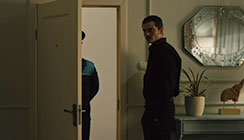
It’s a virtuosic moment truly worthy of the screenshot
reflex: a mysterious, possibly highly villainous character is at last shown to
us, after previous distant views, closer-up – but not all at once. First, he
will be glimpsed just outside the apartment of the central characters –
standing stock still and artfully bisected by the open door frame, so that his
face remains completely hidden.
There is no doubt that debuting feature director Chloe
Okuno (who made an admired episode in V/H/S/94 [2021]) is recalling a celebrated set-up in Roman Polanski’s Rosemary’s Baby (1968), where – as the
director has often proudly boasted – the entire audience automatically leaned
rightwards in order to impossibly “see around” an obscuring door he had planted
in the composition at a high point of enigma and suspense. Even the DOP doubted
the wisdom of this counterintuitive, almost perverse stylistic decision – but
Polanski knew better, well in advance.
That’s not the only trace of Rosemary’s Baby in Watcher.
The sense that Polanski created of a young married couple subtly displaced in a
new environment – in that case, a creepily “old world” apartment building in
the heart of New York – is recreated here in the premise of an American pair
trying to settle into the foreign city of Bucharest (the original script by
Zack Ford, reworked by Okuno, was set in NY). This location is very well used
as a strange, urban atmosphere.
The basic thriller situation – Julia (Maika Monroe),
often alone in the new pad while her husband Francis (Karl Glusman) is away
working, gets continually creeped out by the dark-silhouette sight of a male
“watcher” in the apartment building opposite – draws on everything from Alfred Hitchcock’s Rear Window (1954) and John Carpenter’s Someone’s Watching Me! (1978) to Krzysztof Kieślowski’s A Short Film About Love (1988)
and Steven Soderbergh’s Kimi (2022).
With an extra force due to the times we’re living in: while the heroines of
woman-in-peril films have long faced accusations of delusion and hysteria
(going back to at least the 1940s), now there’s the truism that, under a modern
patriarchy, all women are going to be routinely “disbelieved” when they raise
the siren of trauma or abuse. You may correctly gather that the male spousal
figure here does not rate well on the scale of empathetic devotion to his wife.
Watcher is a film where what really counts
is not the originality of the premise or theme, but the variations on a given,
escalating situation, the stylistic forms deployed, and the basic
suspense-drive to a finishing-line. On all these levels, Okuno confidently
announces her presence as a director to watch. (She was originally slated to
subsequently direct Bodies Bodies Bodies [2022], but that job went to Halina Reijn.) It’s refreshing to watch a
contemporary genre film where, for once, the generally static camera
placements, one to the next in the découpage,
are evidently well-considered, economical and expressive. (No sloppy handheld
stuff here, and no ‘you are right there’ follow-shots for action clinches.) A
film where off-screen space matters, and its effects are carefully calculated and
modulated from moment to moment.
The actors – particularly Monroe and Burn Gorman as
the watcher (but then again, isn’t Julia herself also, logically, a
return-watcher?), so strikingly different from his outsize part as Charlie
Bludhorn in the making-of-Godfather TV series The Offer (2022) – handle their roles well.
And the thriller-mystery mould bends at key moments to include some fleeting
but appropriately gruesome moments of gore – those are the screenshots you
shouldn’t try to post on Facebook.
© Adrian Martin 5 October 2022 |


