 |
 |
 |
 |


|
|
|

|
Ushpizin
|
 |
|
In
a world scarred by the plight of displaced people – exiles, refugees, those
held in detention centres – many contemporary philosophers have returned to
pondering the ancient Greek code of hospitality.
Are we willing to extend “unconditional generosity” to the stranger who comes
to us in need? Or are we going to reinforce the barriers and exclude these
outsiders with ever greater violence?
A
handful of modern filmmakers, including Claire Denis and Michael Winterbottom, have
also become preoccupied with dramatising these urgent questions. Gidi Dar’s Ushpizin (“The Guests”) finds a perfect
situation in which to deal with the issue: the Jewish holy day of Succoth, on
which those of the Orthodox faith live in a small wood dwelling and adhere to a
strict “open door” policy – anyone who shows up must be welcomed in and looked
after.
But
what if these guests are socially undesirable characters? This is the dilemma
faced by Moshe (Shuli Rand), who cannot readily admit to his wife, Mali (Michal
Bat Sheva Rand), that the acquaintances who appear at their makeshift door,
Eliahu (Shaul Mizrahi) and Yosef (Ilan Ganani), have criminal associations –
and that Moshe himself once ran with these wolves.
This
is a story about the ambiguity of good fortune, and the spin-off curse that can
accompany any seeming miracle. Much of its first half is devoted to the married
couple’s agonising search for enough money on which to survive, let alone act
in accordance with the principles of the Succoth. The intense faith of Moshe
and Mali – so palpably conveyed – is answered. But how are they to learn the
true lesson of the strange gift delivered to them?
Dar
made this film under conditions of complete respect for his subjects and their
lifestyles, even though he is himself not Orthodox. Convincing Rand, who was
formerly a huge star of Israeli cinema, to once again appear on screen meant
casting his real-life wife alongside him. What a gift this turned out be for
the filmmaker: Michal is a superb actor, and the scene where, alone in her
kitchen, she belts out a pop song in holy praise is priceless.
In
an American thriller, the plot premise of Ushpizin would be treated extravagantly, in terms of menace and paranoia. We would be
waiting for the violence and rape to erupt, for the dead bodies to appear.
Although there is tension in Dar’s film, he admirably maintains a light tone
throughout – so much so, that the act of hiding under a bed or playing loud
music in a communal courtyard register as the high points of physical action.
And
besides, any movie in which the dramatic crucible turns out to be a
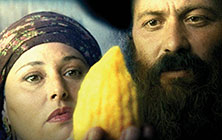
particularly lovely and expensive lemon has to be something special.
© Adrian Martin February 2006 |


