 |
 |
 |
 |


|
|
|

|
Unfair
Competition
|
 |
|
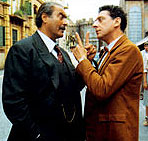
If one needed proof of the difference in sensibility between European and English-language cinema, there could be no better comparison than that between Fred Schepisi's overrated Last Orders (2002) and Ettore Scola's Unfair Competition. In much British, American and Australian cinema, the realm of personal life, whether happy or sad, is presented as a fortress erected against the outside world. Individuals live, love, cry and die, scarcely touched by the waves of history or changes in society. This kind of ingrown drama evident in Last Orders would be incomprehensible to veteran Italian filmmaker Ettore Scola (A Special Day, 1977). Like many of his national mentors and contemporaries, including Vittorio De Sica and Bernardo Bertolucci, Scola is instinctively drawn to stories in which the humanity of characters is both revealed and tested in the crucible of social conditions. Set in 1938, Unfair Competition looks at the moment when race laws discriminating against Jews were passed in Italy. Scola approaches this topic gradually and obliquely, through comedy. Umberto (Diego Abatantuono) and Leone (Sergio Castellitto) have adjacent, competing tailor shops. Whatever theme Umberto dresses his window with, Leone instantly finds a way to capitalise on it. Like Malena (2000), Scola uses the innocent perspective and voice-over narration of a young boy. But the aura of innocence quickly fades as the effects of politics begin to make themselves felt in every corner of daily life, and Leone's family begins to suffer. Paradoxically but touchingly, these changes in the social climate serve to bring the warring professionals, Umberto and Leone, closer together. This is a subtle film, despite the earthy jokes and the presence of Gerard Depardieu as a teacher who, in private, curses the "loss of irony" in a Fascist Italy. As in many fine Italian dramas, huge historic events (such as the Holocaust) loom as faint storm clouds on the horizon. We read the coming tragedies of the times in the small but powerful schisms between individuals. Scola offers it less as a film about grand injustice than creeping indifference, a banal, ordinary form of evil. Scola is by now an old maestro of Italian cinema, and at times his ultra-classical approach borders on the academic. There are moments where one longs for a bold touch to rupture the calm stateliness of the design, colour scheme and sub-Morricone musical score. But, by the time we reach the understated but shattering final scene, Scola's own professional modesty pays off handsomely. MORE Scola: Le Bal © Adrian Martin July 2002 |


