 |
 |
 |
 |


|
|
|

|
The Testament of Doctor Cordelier
|
 |
|
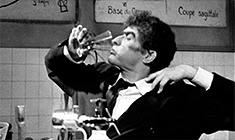
Co-author: Cristina Álvarez López The Brotherhood of Opale Jean Renoir’s The Testament of Doctor Cordelier, shot using the multi-camera set-up of a television production, is a free variation on Robert Louis Stevenson’s immortal tale, Strange Case of Dr Jekyll and Mr Hyde (1886). However, Renoir’s take on this material owes less to the horror genre than to a kind of speculative, philosophical fiction. Unlike in most screen versions of the Jekyll/Hyde duality, Renoir goes easy on the conventional distinction between the good and evil sides of a single personality. Yes, the figure of Opale, into whom Cordelier transforms himself, is destructive, bestial, cruel and sadistic. But he is less immoral than amoral – an expression not of evil but of uninhibited, lawless instinct, an incarnation of desire unleashed. As so remarkably embodied by Jean-Louis Barrault (famous for his portrayal of Baptiste the mime in Marcel Carné’s Les Enfants du Paradis [1945]), Opale takes his proud place in a special cinematic lineage. His physical tics, his anarchic games and wild expressions, look back, first of all, to the past. The past, not least, of Renoir’s own films, particularly Boudu Saved from Drowning (1932), in which Michel Simon played the unsocialisable tramp of the title. All tramps in film tend to refer back to the archetype: Charles Chaplin. Even when transformed into the character identified only as “A Factory Worker” in Modern Times (1936), Chaplin’s familiar Everyman is a zany mixture of inputs (such as the demands of assembly-line work) gone mad, and outputs that express, in a childlike manner, every kind of basic instinct: for food, sex, cigarettes. Fast-forward to contemporary cinema: Denis Lavant as Monsieur Merde in Leos Carax’s episode of Tokyo! (2008), a character later reprised in Holy Motors (2012) and briefly in It’s Not Me (2024), pays explicit homage to the antics of Opale. Just as Renoir downplays traditional moral distinctions between good and evil, he also eschews a comfortably humanistic psychology. Cordelier is not really some tormented, divided self. The Opale that bursts forth from him is not an individual case of unresolved issues, but the purely physical expression of a life-force – no matter how outrageous or cataclysmic the effects of this force on the constrained, public, social world. Our audiovisual essay The Brotherhood of Opale (2017), inspired by the brute physicality of Renoir’s and Barrault’s interpretation of Stevenson, traces the path of certain postures, gestures, actions and reactions that echo through this glorious Brotherhood. MORE Renoir: The Diary of a Chambermaid, The Woman on the Beach, Partie de campagne © Adrian Martin Cristina Álvarez López and Adrian Martin July 2017 (+ update) |


