 |
 |
 |
 |


|
|
|

|
Pharaoh
|
 |
|
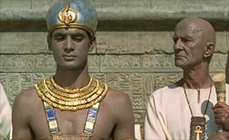
Since the late 1990s, filmgoers have become accustomed to seeing certain visual phenomena conjured by CGI (computer-generated imagery) – and only very approximately or sketchily staged within the real, physical space in front of a movie camera. High in this genre of fabricated apparition come crowd shots: packs of hundreds of civilians in the street or soldiers on the battlefield. From Martin Scorsese’s Kundun (1997) through Oliver Stone’s Alexander (2004) to whichever epic TV event is currently streaming, the ‘cut, multiply and paste’ principle of crowd imagery is often painfully visible to the spectator’s eye – depending on how much of the budget has been left for post-production finessing. It’s possible, in the worst instances, to pick out the tiny assembly of living extras who have been coined into a distant, ghostly horde. Once such serial procedures became common to video-game visualisation, it was only logical that conceptual art pieces (such as those by Baden Pailthorpe) would tinker with and exaggerate this mechanical, unreal, potentially infinite unfolding – showing armies marching forever through desert sands …. Jerzy Kawalerowicz’s Polish super-production Pharaoh, however, hails from a proudly pre-digital moment in cinema – the painstaking preproduction began in 1962, and it was theatrically released in 1966. We are scarcely beyond the opening credits when Jerzy Wøjcik’s CinemaScope camera takes the opportunity to track ahead of a running man for almost a full minute – casually passing literally hundreds of obediently waiting soldiers holding spears. The effect of this spectacular (if seemingly offhand) mise en scène is certainly impressive, yet it is not exactly the type of vast, lyrical grandeur we know from adventure classics like David Lean’s Lawrence of Arabia (1963). The geometry of ‘crowds and power’ (to use the title of Elias Canetti’s 1960 non-fiction book) as displayed here may be entirely real, but the mood is deliberately colder and harsher than anything cooked up with CGI. Indeed, Pharaoh can be regarded, in its time as now, as a veritable anti-Lawrence. The setting is Ancient Egypt, as young Prince Ramses (Jerzy Zelnik) – a figure invented by Bolesław Prus for his globally successful 1897 novel – prepares to take the place of his wise father (Andrzej Girtler) and become Pharaoh number XIII. Ramses’ enemies, however, are legion, since he opposes himself to the Priesthood – a gang of rather sinister, secretive and strikingly bald-headed characters who wield enormous social power. In fact, their ability to manipulate the mass population into storming the central Palace is a stunning prophecy of the actions of one Donald Trump! Step by step, the film calmly traces the moves and counter-moves of a complicated power game. There are clandestine agreements, formal inquiries, and the accounting of dazzling gold reserves deep inside the Palace labyrinth. And Ramses even has a disquieting doppelgänger (a detail which may not become clear to you in a single viewing). Kawalerowicz is careful to break up the scenes of oppressive interior spaces with sometimes cruel bouts of action out on the desert sands (filmed mainly in Uzbekistan). Music (by Adam Walaciński) is sparsely laid on: the anguished sounds of howling winds or murmuring crowds remove us irrevocably from the gaudy ambience of such Hollywood epics as Michael Curtiz’s The Egyptian (1954) or Howard Hawks’ Land of the Pharaohs (1955). In an intriguing paradox of cinema’s powers of historical recreation, as certain recurring details (such as the elaborate headdresses of women and men alike) get weirder and more surreal, the more authentic they seem. Ramses XIII is a captivating anti-hero, lightly resonant with the many real-life youth rebellions of the 1960s. Dark-skinned, forever brooding, tragic hubris running high, he is unafraid to scandalise his imperious Queen mother (Wiełsawa Mazurkiewicz), or follow the urgings of his libido with the faithful, pious “Jewess” Sara (Krystyna Mikołajewska) and, subsequently, the more slippery Phoenician femme fatale Kama (Barbara Brylska) – although only a slender piece of transparent clothing differentiates these women in Kawalerowicz’s depiction of their alluring charms. There is a remarkable scene in which Ramses, in torment and at odds with his various advisors, begins to twist and contort his limbs – and Zelnik’s intense performance resembles nothing so much as James Dean in Rebel Without a Cause (1955), to the point where you expect him to cry out: “You’re tearing me apart!” Within the context of Polish cinema history, Kawalerowicz (Mother Joan of the Angels, 1961) is a formidable but also reasonably official, mainstream figure. Nobody could mistake the high style of Pharaoh with anything that, say, Jerzy Skolimowski was merrily inventing on the cheap during that same period in Walkover (1965) or Barrier (1966). By the same token, Kawalerowicz is far from being a rigidly classical director in the mould of Lean or Fred Zinnemann. Doubtless taking a cue from the aesthetics of the ancient Egyptian art that is generously displayed in the magnificent sets (built in a Łódź studio), Kawalerowicz aims for a frequently frontal, presentational effect – complete with many looks directly into the camera. Even the camera movements follow a rigorous, geometrical logic, performing sudden sharp turns and whip pans. There is an affinity here with the pictorial styles developed by Sergei Parajanov and Miklós Jancsó during the ‘60s and ‘70s. The stand-alone Blu-ray release of Pharaoh by Second Run is an event to be celebrated. Although commercially successful and critically lauded in its day, the film, in all its big-budget splendour, had largely fallen out of circulation for many years. The beautiful restoration by Studio Kadr – which Kawalerowicz founded in 1955 and presided over until his death in 2007 – has previously been available to English-speaking audiences only on Volume 1 of Scorsese’s Masterpieces of Polish Cinema boxset in 2014. In a splendid, 68-minute video “Afterword”, Michał Oleszczyk, seated behind a desk, delivers to camera a highly informative rundown of the various historical and cultural contexts that feed into Pharaoh – including its provocative allusion to the continuing influence of the Catholic Church over 1960s Poland. More disc producers should use this straightforwardly academic lecture format and drop the often stilted ‘interview an expert’ device. © Adrian Martin May 2024 |


