 |
 |
 |
 |


|
|
|

|
My Room Le Grand Canal
|
 |
|
Notes on a Work In
Progress
In
1998, I had the privilege of seeing a work in progress by French artist
Anne-Sophie Brabant, prepared as part of her residency as Media Arts student at
Royal Melbourne Institute of Technology (RMIT), Australia. One version of this
work eventually became the film My Room
Le Grand Canal, co-made with Pierre Gerbaux, and partly financed by the
Australia Council. Even in its unfinished state, it impressed me as a
sophisticated and accomplished work in the realm of experimental, audiovisual
aesthetics.
I
saw a video which was a fragment of a larger installation project involving two
rooms. Brabant’s working notes were made available to me as I watched the work.
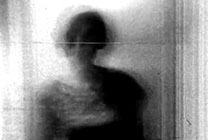
The video showed two performers (Brabant & Gerbaux) engaged in various
dance-like movements and gestures – about ten minutes of material looped to
repeat indefinitely. “The film recounts the birth of a story”, writes Brabant. “An
organic, sexual story. A man and a woman in an empty house. Their relationship
is strange; we don’t know whether they love one another, are searching for one
another, or destroying each other. Little by little they disappear, submerged
by their own desire. Submerged by Venice and its canals”.
Many
sensations and thoughts swirled in and around me as I took in these images. We
enter into a figural drama of identity: Self and Other, and the ever-permeable
border between them. We study the nature and composition of movement – both the
movements of bodies and the movement of the filmic grain and texture. We test
the legibility and limits of this sensorium created together by the dancers,
the camera and the film (turned video) strip, swimming in its associative
fields.
The
images I viewed were extensively treated. The temporal progression of the
frames, their colouring and pictorial distortion – all this gave the impression
of something not only fluid and mysterious but also archaic, “images pulled up
from under the ground” as Elias Merhige said of his film Begotten (1989). In the manner of Stan Brakhage or Gregory Markopoulos,
Dziga Vertov or Sergei Eisenstein, there is much play on raccords of various kinds between the images – creating deliberate
confusion of body shape and gender identification, as well as ambiguities of
facial and physical expression.
Whenever
the human body is slowed down, accelerated or in some way deformed or
de-figured, a paradoxical openness and richness of expression results: we are
suddenly between pain and pleasure, exaltation and exhaustion. We no longer
wish to put a brake on this spinning-top of affective signification. All the
while, an abstract, non-sync soundscape accompaniment enhanced the mystery of these
displacements and glissements.
This
strip of images and sounds is also the setting for another drama to be built
and orchestrated by the artist – and by the spectator, too. According to
Brabant, the placing of a monitor in one room, and the access to it from a
second room, would serve to both “de-mix” the sound and “de-edit” the video.
Lured into that room, we alter the dynamic composition of the video from the
moment we open the door. This would be, in all, a discontinuous space of
encounter and future memory – for the piece has no clear beginning or ending,
and comes into being only from when, and for however long, one stays with it in
that room.
As
one departs, its literal echoes, and its lingering sensations, remain with the
viewer in order to become part of another tale, some other intersection of
bodies, images, surfaces and sounds.
Note: four
clips from My Room Le Grand Canal are viewable on Anne-Sophie Brabant’s Vimeo channel: https://vimeo.com/user22595764
© Adrian Martin August 1998 |


