 |
 |
 |
 |


|
|
|

|
The Mad Heart
|
 |
|
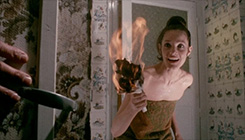
The Mad Heart is an odd, lopsided, rather forgotten film that, for its director, probably hit the market about three years too late. (Cahiers du cinéma merely listed it, without review, among ‘French films released’ in its month – having already debunked this would-be auteur at the end of 1962!) It is ‘post 68’ only in a faint, gestural way: Maurice Garrel appears as the head of a psychiatric clinic-residency two years after his role in his son Philippe’s wildly anarchic Marie pour mémoire, which is the real deal in feature-narrative-avant-garde terms. Jean-Gabriel Albicocco himself has a disconcerting biography that places him almost perpetually offside of sustained success. After a prolific, precocious start as a film-geek in his 1950s childhood, he bathed in a reflected Nouvelle Vague aura for a few films until the mid ‘60s; then the box office failures (including The Mad Heart) started accumulating. He died, penniless, in Brazil at the age of 65, having renounced France and its movie culture during the 1980s. In The Mad Heart, Albicocco’s impulse is more romantic than political. Serge (a brooding Michel Auclair – Flostre in Funny Face [1957]! – a little in the vein of a pre-dissipation Serge Gainsbourg) checks on his ageing, celebrity wife locked up and sedated in a luxurious asylum. He is instantly shadowed by young Clo (Ewa Swann – IMDb tags her as a ‘cover-girl’!), an extremely psychotic patient with a special flair for pyromania. Her role is, thus, curiously prophetic of two vastly better Werner Schroeter films: Day of the Idiots (1981) and Malina (1991). You start to wonder, while watching the Mad Heart, how much fire is real and how much is special effects; you begin to feel anxious for the cast and crew (and even the sets!). Serge is middle-aged, still sore about his failed marriages, dissatisfied, mocked for his failing virility (male fistfights are a key motif!) and generally mopey. That seems to be reason enough for him to fall head over heels for the ever-disturbed Clo. They hit the leafy highway, visit a small town, and camp out in various woods – setting a few gleeful fires along the way. For a film supposedly so bent on celebrating freedom, it is oddly silent, for a long stretch, on the subject of sex: finally it happens (unseen) between the central pair, and instantly she is pregnant. It’s a Paradise Regained fable, set (for the idyllic sections) entirely outdoors. The Mad Heart is clearly, in Albicocco’s mind, a fusion of two model inspirations of the pre ’68 period. The rosy glow of madness, and the hero’s ‘dangerous obsession’ over it, are straight out of Robert Rossen’s modern classic Lilith (1964) – a film which (as Jacques Rivette testified circa ’67) influenced a great many French directors. And when it comes to the lovers lolling in Nature’s Paradise – catching fish, constructing a flimsy shack – we are back to the most lyrical part of Jean-Luc Godard’s Pierrot le fou (1965). That, in turn, returns us to the ‘island idyll’ tradition that Alain Bergala has defined so well in relation to Ingmar Bergman’s Summer with Monika (1953) – Serge and Clo even manage (in a somewhat unconvincing geographical layout) to stake out their own, tiny, island kingdom, leading to a vividly stylised, 360-degree panorama finale. That finale is seen coming from a long way off in screen-time terms: it will be when law-enforcing normality, conventional morality and everyday sanity finally catch up with our loopy, amour fou heroes. (Along this trail, there’s even an echo of another prime influence from 1967: Bonnie and Clyde – and not only Arthur Penn’s film, but the Gainsbourg/Brigitte Bardot pop hit of ’68.) The Pleasure Principle trounced by the Reality Principle, yet again. Cinema was born for this! I rarely complain about ‘bad performances’ in cinema, but Swann is surely not up to the part of Clo: she has to cry and freak out a lot, and she mainly conveys this by heaving her shoulders up and down frantically (post-sync sobbing doesn’t help, either). Auclair is, by comparison, much cooler. Albicocco was surrounded by his then-regular team of collaborators, including co-writers Pierre Pelegri & Philippe Demarcay, and composer Jean-Pierre Bourtayre – although I suspect that the very intriguing, regular blasts of non-melodic noise on the soundtrack may belong to credited ‘music supervisor’ Jean-Claude Vannier, a Garrel collaborator and creator of the incredible L'enfant assassin des mouches album (recorded ’73, released 2003). Also in the familiar crew is Quinto Albicocco – Jean-Gabriel’s father. His cinematography ratchets up the excessive aspect of The Mad Heart. On the one hand, it is hyper-lyrical in the then-recent, fashionable, glossy-TV-ad manner of Bo Widerberg’s Elvira Madigan (1967, another lovers’ idyll number) – every second exterior shot brandishes the sunlight streaming through tree branches. On the other hand, the spatially warping lens and blurry optical effects (laid on thickly) recreate Eugen Schüfftan’s indelible work in Lilith – but this time in hallucinogenic colour. An optical unconscious? © Adrian Martin 25 October 2026 |


