|
 |
 |
 |


|
|
|

|
How Do You Know
|
 |
|
Without the expected question mark at the end, How Do You Know sounds like the mangled title of a quickie self-help manual: How to Know … but know what, exactly? In the context of a particular scene (an intimate chat between sports jocks on the sidelines of a game-in-process) in James L. Brooks’ film, the specific question is: how do you know when you’re in love? (Jock answer: when you start using condoms with the other women.) So: How To Know Thyself. But
also, as always in Brooks, that issue is ghosted by a far more
complex one: how to know anybody else? Having just lost her position
on a softball team, Lisa (Reese Witherspoon) spends almost the
entirety of this story trying to figure out – sometimes angrily –
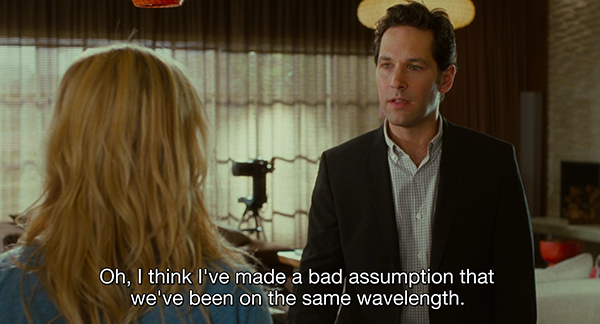
how to ‘read’ the responses of the two guys she tussles with:
George (disgraced businessman Paul Rudd) and Matty (ever-popular
sportsman Owen Wilson). And those guys are always putting their foot
in it, saying the wrong thing, adopting a mistaken assumption …
Mutual incomprehension is the default setting of Brooks’ richly
interpersonal cinema. And that drags in an almost constant texture of
embarrassment, crossed wires, double-takes of delayed
realisation/recognition, and verbal-emotional explosions of every
kind of exasperation.
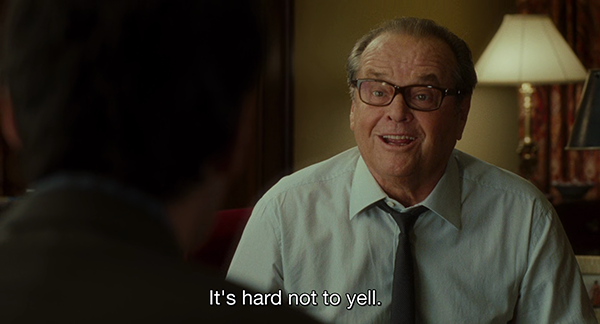
I had to try this movie three times before I truly got it. The first time was on a bus – where the screen was not even embedded in the seat in front of me, but hanging from the roof halfway down the aisle, and me with tinny little transmitters stuck in the ears; not optimum viewing conditions for anything, I know. So, I got nothing that time. Second time was a more proper watch (on my laptop), but I was still not really engaged: it seemed repetitive to me (as Brooks films can sometimes be), just one scene after another of miscommunication, and Lisa storming out on one guy or another … plus a shadowy, unresolved subplot involving George’s shark of a father, Charles (Jack Nicholson). I wondered, then, whether Brooks had trapped himself in a predictable groove of exacerbated comedy. Third attempt (while gearing up for Ella McCay [2025]!), I took my time, and tried to dispense with every prior expectation of what it would or should be doing as a film. Genre labels (such as romantic comedy, domestic family comedy, whatever) never help in the appreciation of Brooks. Nor do any of the dozen different ‘models’ today governing how a narrative – especially a Hollywood narrative – needs to proceed. Take, for instance, the idea of a central plot motor, which I usually find fits even the jazziest of narratives: that nutshell, dilemma or situation which crystallises (usually within the first 15 or 20 minutes) what a film is essentially about and where it will go, or at least what it will explore. Such motors hardly exist in Brooks. There’s a complicated field of relations which unfolds, expanding gradually, knitting up here and there – and not always resolving itself on all counts. It’s always a high-wire act for the film to keep all these elements in a permanently unstable, disequilibriated equilibrium. Conventionally, How Do You Know can be
taken as following a His Girl
Friday-type ‘one woman hesitating between two men’
plan (just as Broadcast
News [1987] did). However, by basically following
Lisa (who gets the typical Brooks pre-credit ‘childhood flashback’)
in and out of various places and situations – her place, Matty’s
place, George’s place, a restaurant, the street – the film
deliberately denies us much of the male or female oneupmanship that
rom-coms of this kind usually serve up (think of The
Awful Truth [1937]). Nor does it trace an ascending
‘arc’ of awareness on Lisa’s part: even in the final scene,
when true love is supposedly blooming in a reciprocal fashion, she’s
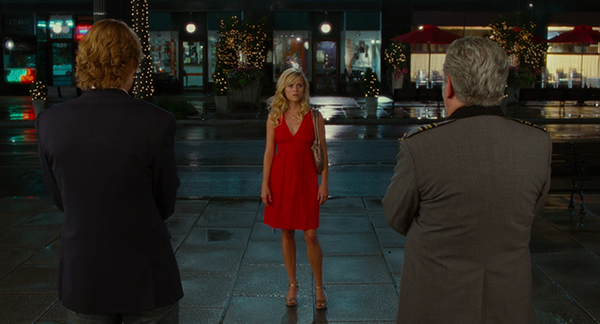
still bothered by George’s habit of staring at her. The final,
empty frame is eloquent of what is yet to be or never will be
resolved – just as the superbly economic last view of Charles,
turning his back to the camera in a long shot and heading back into a
room of lawyers, effectively draws a line under that part of the
plot.
In an Ernst Lubitsch film, what I love is the systematicity of repetitions, comparisons, inversions; it’s always so perfect, you can (try to) draw a diagram of it. Brooks does something different, more challenging for his audience: there are motifs and patterns galore, but they give the appearance of idly falling into place almost accidentally (as if!), as part of the ceaseless flow of detail. That, too, is part of their achieved texture. Some
examples: three different characters, at different (widely separated)
moments, speak casually of “catching themselves” in a certain
behaviour, and quickly recanting or reversing their course – a form
of self-knowledge that, most of the time, strenuously eludes them.
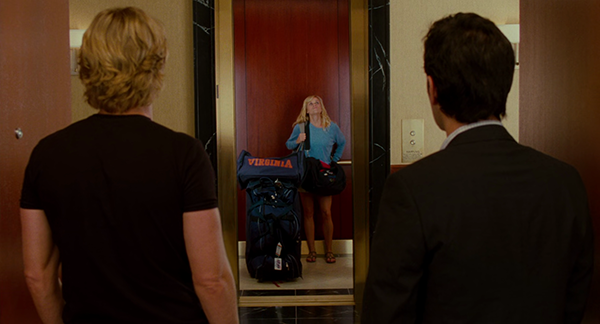
Or: triangles. Matty and a doorman facing Lisa; George and Matty
watching Lisa in an elevator; Charles watching, from above, Lisa and
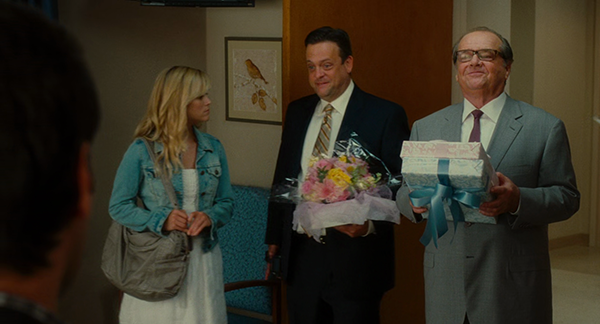
George; and, funniest of all (no spoiler), the confusion engendered
by dual male appearances at the hospital door of Annie (Kathryn
Hahn), who has just given birth. Or: the only occasional but always
telling framing of characters in long shot, forcing brutal
realignment of perspective on a scene.
If there something resembling a mid-point in this two-hour film, it rests upon a prime detail that most other films would have set-up far earlier: the fact that Matty and Charles live in the same, up-market apartment complex (knowledge cued by the fact that Lisa and George suddenly find themselves in the same elevator on two different missions). But that is about as much clear ‘structure’ as you should ever expect from Brooks. On the one hand, his narratives are rhizomes that spread out; on the other hand, they worry over the same neurotic knots and misunderstandings which duplicate themselves in every relational interaction. They stick with that trouble. Something
that never ceases to amaze me in Brooks, and that closely-watching
with the pause and screenshot buttons handy makes hyper-evident: with
his brilliant actors, he arrives at certain expressions, gestures,
physical configurations of befuddlement or defeat or exhilaration
that you’ve never seen before, exactly like this, in any other
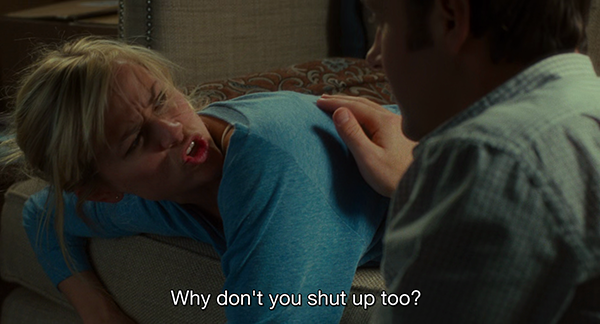
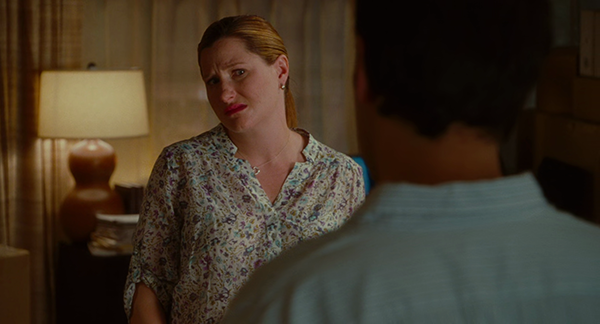
movie. Annie sizing up the validity of what George has just said to
her, or blowing up when he has got an all-important task wrong at the
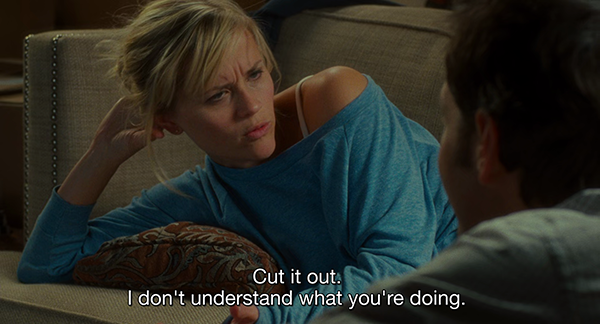
hospital; Lisa reacting to George’s mixed-signals with “Cut it
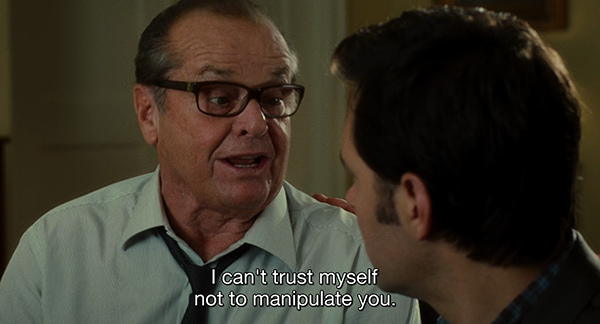
out. I don’t understand what you’re doing”; Charles’ patently
hypocritical ‘wrestling with himself’ as he pleads to son to take
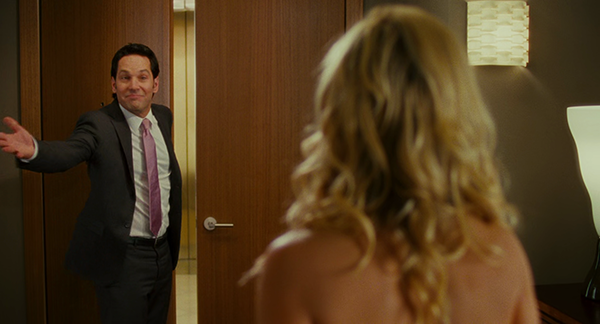
the legal indictment rap; George waving a doorway farewell (so many
doors in this film!) that is a mix of resignation, bitterness and
anger …
Above all, it could be that How Do You Know suffered – at the box office, and in the hands of dopey reviewers/critics – because of that ‘missing motor’ referred to above. There is no special novelty in its narrative premise, no evident marketing hook beyond the stars whom Brooks can attract into his brave, experimental game. The characters are not as obviously ‘damaged’ as in As Good As It Gets (1997); we don’t reach the family-based feel-goods as in Terms of Endearment (1983); the workplaces glancingly depicted are not as spectacular as the TV studios of Broadcast News – naturally, since both Lisa and George are satellites spinning out of their safe professional cocoons from the very outset of the story. Brooks
eases into a more ordinary situation of emotional, intersubjective
vacillation here, and has the courage to mine it for all it’s
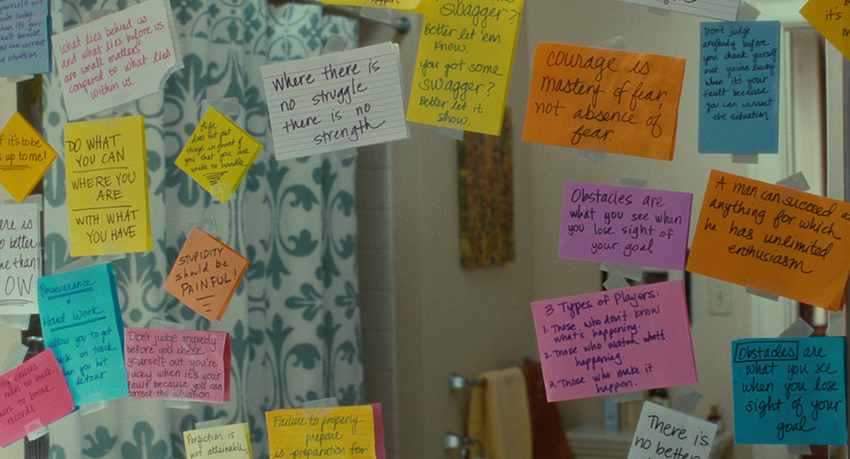
worth. The emblem of that is another empty (i.e., depopulated) frame,
showing all the motivational Post-it notes Lisa has sprayed all over
her bathroom mirror (and which she intermittently recites during
dialogues). How do we come to know anything? Not through that bunch
of clichés, for sure.
|