 |
 |
 |
 |


|
|
|

|
The Green, Green Grass of Home
|
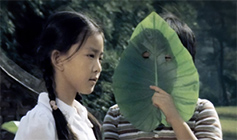 |
Co-author: Cristina Álvarez López A Sweet Little Village The Green, Green Grass of Home was a key transitional film for Hou Hsiao-hsien, between his first two romantic comedies of the early 1980s – Cute Girl (1980) and Cheerful Wind (1981) – and then, after it, the more personal The Boys from Fengkuei (1983). As the film’s title, with its allusion to the famous Tom Jones pop ballad, tells us, it is a film of nostalgia, and yet played out in the present day. Like his other early movies, it is about the difference between country life and city life – except that, this time, it is almost entirely set in a single village, apart from one brief city sequence. It is the last film that Hou wrote on his own, before beginning his lifelong collaboration with the acclaimed novelist, Chu Tien-wen. But we can already see the beginning of an episodic narrative structure greatly favoured by Hou, based on a gentle interweaving or interleaving of diverse strands of the story. Literally large elements – such as the natural landscape or built environment, with its rituals of rice reaping – are mixed with small, intimate details, like the discovery of a wounded owl. The supposed main lines of this story – involving, in part, a new schoolteacher from the city, Ta-nien (singer Kenny Bee from Cute Girl), and his love affair with a local colleague, Su-yun (Chiang Ling) – are intermingled, democratically, with diverse anecdotes and vignettes involving the schoolchildren and their family situations. Through such an interwoven, mosaic approach, Hou conveys to us the rhythm, tone, daily rituals and values of a country lifestyle. It’s a film of walking and working and bicycle riding, set in a social space where everybody observes or collides with everybody else. Hou’s cinematic style begins to become more confident, more definite in its strokes here. There are only a few swift zoom shots, or the type of zany, wandering, chaotic action that characterised Cute Girl. The camera set-ups are now more static, more assured; the staging is more precise, the focus of the lens is carefully calibrated, and Hou resists the temptation to cut away when something interesting in the shot – like a child’s monologue – can very well hold our attention. In The Green, Green Grass of Home, the city-and-country comparison is embodied mainly in the character of Ta-nien. In a sequence set in a theatre, he is an exuberant exhibitionist, a city boy – but Hou is not only showing off his star. He is also prefiguring how this performance space, with its potential for spectacle and applause, will return prominently in the film’s resolution. This is the first film in Hou’s career where he will start to portray, in an apparently offhand but actually closely observant way, certain rituals of everyday life that fascinate him – such as the preparing, eating and sharing of meals, which is an important thread here and in all his subsequent movies. It is an important principle of screen comedy (including romantic comedy) that personal difficulties, humiliations, shameful incidents (and so on) are played out in full view of a group of people. After all, private agonies are a lot funnier when they are exhibited in public. This is especially true of Hou’s variation on Taiwan’s popular “healthy realism” genre from the 1960s: the whole community here has a kind of collective metabolism, an equilibrium that must be respected and preserved. Actions have consequences! In one scene, it’s the hysterical, over-emotionally-dependent visitor from the city who upsets this necessary balance – and everyone, younger and older, sees and notices the catastrophic effects on the growing relationship of Ta-nien and Su-yun. There is a sentimental side to Hou’s cinema, which critics too often underrate or overlook. As Stephen Teo has stated, Hou skilfully mixes the conventions of both romance and melodrama in order to evoke the emotions of “joy, music, love, laughter, and sorrow”. Nowhere is this clearer than in Hou’s presentation of children. He experienced a liberation, as a director, working, in a semi-improvised way, with the kids in this film – including his own young daughter, who appears in the delightful, final concert that cheerfully dramatises the story’s environmental, ecological theme. Hou enlarges his stylistic repertoire of techniques. In one scene, he records in a single shot, panning and zooming from a fixed position, Ta-nien’s exit from the train; then his interaction with the ticket collector; his return to the carriage to get his ticket; and his exit through the gate. In the sequence of a boy’s excited return home – to collect his own faecal stool for school health inspection! – we see an ambitious arrangement. The camera tracks on a crane; it pans and tracks to reframe the scene though a grilled window (like in a Max Ophüls film); it moves again to open up a deeper space, revealing the boy’s mother at work; and finally it shows the boy arriving at the toilet. Many viewers will recall Yasujiro Ozu’s comedies of family life, such as Good Morning (1959), during this scene. A circular tracking movement introduces what will become another, key Hou technique: a deep focus exterior, framed through a door. This whole scene plays on the interrelation of different spaces in the house, and the different points-of-view of the characters – gazes and glimpses that are enabled by the architecture of the dwelling, its passageways and sightlines. At the same time, more secret gestures (like the boy’s eating), and wistful looks (such as that given by the little girl), can also be hidden within this domestic, family architecture. Here is a key scene. The two children arrive home cheerfully, only to discover that their beloved owl is not only gone but, in fact, has been murdered by their father, in punishment for its misdeeds. The boy’s reaction, in particular, is powerful: unleashed anger, shouting and hurling objects. Like in a classic Hollywood comedy-melodrama such as Vincente Minnelli’s Meet Me in St Louis (1944), simmering frustrations about the family unit and its rules boil over in a frankly subversive way. Hou records the children’s interaction with the unrepentant father from a single camera position, with deep focus all the way to the background hill. Although the speed of the father’s movements and his high-pitched, post-synchronised voice add a layer of comedy to the events, this is a deliberately disquieting scene. As Ashish Rajadhyaksha has commented, the unexpected eruption of violence in any Hou film places the spectator in an uncertain, distant, somewhat frozen position – a position, in fact, rather like the little girl in the scene, stunned, looking on, even grazed by the boy’s thrown school satchel. Just as Cute Girl is built on a recurring motif of trees, this film is structured around trains. From the very opening shot, the arriving or departing train, the visual presence of the tracks or the station with its familiar platform, give the film not only its narrative form, but also an overall rhythm, tone and texture. Trains are, in every way, part of the everyday world conjured here. They offer routine and regularity, but also adventure, opportunity for play, the arrival of exotic strangers from the city or family members not seen for a long time. Trains renew the life, the respiration, of this country village. Many in-between, transitional scenes show characters walking past the station, or across its tracks, as they talk, going to and from work. It’s part of the ambience of a nostalgic, country life; but also, as frequently in Hou, a sign of development and progress, the transformation (for good and for ill) that the city is inexorably bringing to the country. Finally, the film comes full circle. The ecological story has been resolved, as all the community members participate in an officially approved nature protection program at the river. All the strands of the story – large and small, social and personal – come to a mutual happy ending. The film’s frequently used theme song swells to its most emotional point, Hou using this momentum to make a strong transition to his concluding set piece: Ta-nien’s departure on the train. Hou displays his growing mastery as a filmmaker here. How do you keep a scene like this one going; how do you divide it into phases or stages? First item on the agenda is the romance relationship of Ta-nien and Su-yun. Hou stretches the tension with a rare (for him) shot/reverse shot volley – until she suggests joining him for part-way of the trip. Next, we might think the long, wide shot is the final image – until, in a surprise move, the “three musketeers” (as they are called throughout) break away from the group and run like crazy, the camera performing a crane movement to record their progress. The following two shots, with the boys running, recapitulate the entire geography of the village, arriving at the main road and the adjacent train track. But the film is not yet over. From this static, distant view, Hou takes us into more shot-and-reverse-shot cutting, for the joyous shouting and waving of goodbyes. Ultimately, in what is truly a Hou signature, the film conjures and mixes both youthful energy and retrospective sentiment, via a François Truffaut-style freeze frame. Everything in life, and in the world, is in motion; and yet it all somehow magically clicks into place as a perfect composition – and a sublime encapsulation.
MORE Hou: Good Men, Good Women, Millennium Mambo, Three Times © Cristina Álvarez López & Adrian Martin August 2015 |

 , Hou Hsiao-hsien, Taiwan, 1982)

