 |
 |
 |
 |


|
|
|

|
Get Crazy
|
 |
|
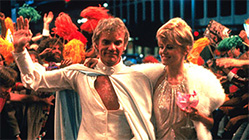
This is an exhilarating mutant musical – the plot of which revolves entirely around the staging of a ‘celebration of the 1960s to usher in 1983’ extravaganza – the 15th such New Year’s bash at the Saturn. In fact, there’s a bit of a muddle right there in the musical-cultural reference set: the set-up has an overwhelming ‘60s & ‘70s vibe – with an extensive nod to The Last Waltz (1978) – but there’s also a palpable desire, on the part of its makers, to somehow accommodate something vaguely comprehended as punk, which takes various bemusing, shape-shifting forms throughout. Get Crazy is also the finest big screen outing of director Allan Arkush, who hails from the Joe Dante/Jonathan Kaplan generation (they were all once students of Martin Scorsese) and, beyond Caddyshack II (1988), has gone on to forge a career in television (with the series Fame, Moonlighting and much else). Arkush here draws upon his (and another Scorsese alumnus, co-writer Danny Opatoshu’s) own life experience as a concert manager at the Fillmore East in the late ‘60s/early ‘70s, and exaggerates it into a wild succession of gags. It is a (shall we say) spiritual sequel to his lively and irreverent Rock’n’Roll High School (1979 – another rock’n’punk mélange), and a little in the vein of Brian De Palma at his most outrageous and cartoon-like in Phantom of the Paradise (1974) and parts of Carrie (1976). Chaos – unleashed in the most diverse and surprising ways at any moment’s notice – is the essential principle of this gag-machine: chaos followed by fumbling or exasperated attempts to set things right. It starts with a Star Wars parody, and swiftly transitions into a play-off of grandiloquent entrepreneur (Allen Garfield/Goorwitz as Max Wolfe) and no-nonsense eye-rollers including lighting gal Violetta (Mary Woronov – there’s too little of her) and stage manager Neil (Daniel Stern). Within the first four minutes, Arkush has clocked up an explosion (causing blackface for Max’s obsequious nephew played by Miles Chapin); a growling, kicked-around dog who you just know will figure in some later plot cap-off; and a dreamy, slo-mo Boy Meets Girl vignette (complete with subtitle) timed to “Just One Look” (enter Gail Edwards as Willie). The subsequent ‘falling out of fantasy’ cut really took off in cinema a year previously in Amy Heckerling’s Fast Times at Ridgemont High. This film rolls that ball recursively. Every troupe-bravely-putting-on-a-show needs its smarmy corporate adversary, and that figure is incarnated in this instance by Ed Begley Jr (emanating a creepy Andy Warhol/Crispin Glover vibe) as Colin Beverly. There’s also a bit of I Wanna Hold Your Hand (1978) present in the subplot involving Neil’s little sister (Stacey Nelkin) desperate to see the show, but that Robert Zemeckis film is Social Realism compared with this. Arkush is working more in the vein of Tashlin’s The Girl Can’t Help It (1956), suitably modernised – there’s even an interlude for animation. Drugs enter at the 10-minute mark with a masked-in-black character named Electric Larry (this must surely be among the most enthusiastic pro-drug comedies made since William Dieterle’s Jewel Robbery [1932]) – allowing fast-mo to be paired with sped-up playback of “Wipeout”! The bands arrive one by one (but with plenty of delays so as to stretch things out): hippie ensemble Captain Cloud (Howard Kaylan) and the Rainbow Telegraph, punks Nada (Abel Ferrara associate Lori Eastside) and Piggy (Lee Ving), black King Blues aka The King of the Blues (Bill Henderson) with his protégé Cool (Franklyn Ajaye), and the legendary, reclusive “metaphysical folk singer” Auden (a droll Dylan parody and self-parody from Lou Reed, who gets to do the final song alone on stage, “Little Sister”). 1960s/‘70s fans will enjoy Malcolm McDowell’s take-off of Mick Jagger (ahem, Reggie Wanker) – associated, weirdly, with T Rex/Marc Bolan riffs (I guess it’s all Brit Rock), and actually most like Beef from Phantom of the Paradise. Reggie is an odd but workable amalgam: there’s a bit of Bowie in there as well, and at one point he incongruously laments: “Am I still a punk?” But was he ever? Meanwhile, the ‘80s crowd is given plenty of play in the (large) space between Bananarama and The Ramones. There’s also a great bit about an extended drum solo. And a talking penis. It takes quite a while for the actual music performance element to kick in – the build-up is exquisite. The Saturn’s doors open at the 32-minute point; many audience-entry jokes follow. There’s seemingly no need for anyone to rehearse or sound-check, but King finds out backstage that, instead of a blues band, he has been supplied with a Jews band.* But the Show must go on, right now! 37 minutes: finally, a song, and it’s about how “the blues had a baby and named it rock’n’roll”: all music styles are on a family continuum here.** (Indeed, not one but two subsequent acts cover “Hoochie Coochie Man”.) King’s set covers the next 8 minutes of the film, which is quite generous … since most music-related fictions cut the numbers ruthlessly. And that, pleasingly, sets the pattern for everything that follows. Intercutting of various subplots and trajectories maintains the frenzied momentum. This
is a movie that deserves to be loved. Crazy love!*** * This could be a scene from Walk Hard: The Dewey Cox Story (Jake Kasdan, 2007). ** And since Sparks provides the sarcastic title track “Get Crazy”, the continuum stretches to Leos Carax’s sublime musical (with spectacular concert scenes), Annette (2021). *** An excellent DVD/Blu-ray edition appeared in 2021 from Kino Lorber. © Adrian Martin 17 May 1990 (+ asterisks 2026) |


