 |
 |
 |
 |


|
|
|

|
Constantine
|
 |
|
“Heaven
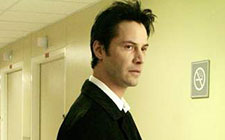
and Hell are all around us”. John Constantine (Keanu Reeves) explains this with
some urgency to his reluctant companion, Angela (Rachel Weisz), in Constantine. He is being neither metaphorical
nor metaphysical: as John can show with the mere flare of an appropriate light
or a brief immersion in water, thousands of hideous beasts are waiting to
“cross over” onto the human plane.
But
where are the corresponding signs of Heaven? Like so many mainstream fantasy-horror
movies, Constantine is timid about
depicting Heaven (beyond a few fluffy clouds and beams of light), thus
upholding the Old Hollywood taboo about showing God. This leaves the field wide
open for Lucifer (Peter Stormare) and his legion, who get all the best tunes
here. Even the solitary embodiment of Pure Good – Tilda Swinton in a marvellous
turn as a wing-sprouting Gabriel – appears to be quite a shifty trickster.
This
is the feature debut of music video director Francis Lawrence. Wisely for his commercial
prospects, but perhaps unwisely for his critical reputation, he has chosen to
work in a genre disregarded by many tastemakers. Like Hellboy and Catwoman (two underrated
highlights of 2004), Constantine is
an extravagant fantasy adapted from a comic book series. It is best appreciated
on a big, loud screen.
Constantine
is a chain-smoking, hard-boiled type who professes only to care for himself.
But he worries enough about the infringement to The Balance – the cosmic rule
dictating that foul and divine beings alike cannot enter our world – to want to
restore it. And for that he is going to need not only his usual crew of
eccentric sidekicks, but also the superior supernatural power of Angela – a cop
troubled by her ability to intuitively spot and unerringly shoot the bad guys.
The
film bursts with inventiveness. Lawrence has tried, and largely succeeded, in
giving every familiar situation some twist or heightened aspect. This goes all
the way down to the smallest gestures and incidental details. Early on, a
thrilling exorcism scene is constructed around glimpses of Constantine’s
cigarette burning away in the corner. A later moment when Angela confronts her
twin, Isabel, is given added poignancy by the way she carefully arranges the
strands of hair falling down over her face.
But
where this movie truly excels is in its sense
of place. The locations, whether real or artificial, induce a mood that is
poetic as well as menacing. The library where Constantine confronts Gabriel,
the bowling alley where our heroes hide out – even the troubling “loading zone”
for demons that conjures a mass of “illegal aliens” waiting at Customs – all
plunge us into the plot’s reality-shifting vortex.
It
is too easy to fault Constantine for
sometimes seeming like a patchwork of elements from other films: a prologue in
Mexico that evokes The Exorcist (1973/2000), a nocturnal action
scene recalling Pitch
Black (2000), a note of Keanu the Messiah left over from the Matrix series, etc.
But
the whole is greater than the parts, and – for a change – I find myself longing
for a sequel. [2020 Postscript: The
sequel has not yet happened, despite the announced, continued interest of
Lawrence, Keanu, and Guillermo del Toro!]
|


