|
 |
 |
 |


|
|
|

|
Close Encounters of the Third Kind
|
 |
|
Although many hands are said to have pitched in – for the sake of young, budding auteur Spielberg to sign alone – what sticks out overwhelmingly rewatching Close Encounters today is: what a lousy script! For a Hollywood epic, no strongly personified or inscribed ‘central conflict’ whatsoever. (Military folk do a few officially sneaky things along the way, but even they, too, bow in awe at the ultimate sight of the alien spacecraft.) For a long time, a lazy shuttling between two centres (strange deposits around the world; one man’s deranged, visionary journey across America) that take a long time to meet. A sort-of Everyman hero – Richard Dreyfuss as Roy Neary – who has no backstory and almost zero psychology: he’s just an Innocent driven forth by manic, hysterical compulsion. And that’s not even to yet mention the underlying, ghastly ‘family romance’ at play, to which I shall return. It’s fascinating, now, to gauge how skilfully and successfully Spielberg has shifted over to all the conventional virtues in Close Encounters’ ‘answering’ film, Disclosure Day (2026) – this time with the help of a decent screenplay by De Palma’s guy, David Koepp. A definite villain; two sides constantly clashing; strongly interlinked action-drama all the way … and an ending which simultaneously resolves everything and solves nothing. Spielberg at his finest! Close Encounters, for sure, can be situated at some nebulous, shifting point amidst numerous cultural currents – Dana Polan does the best job of nailing this whirlwind down in his 2024 BFI Classics book. It’s a road movie and a ‘give us something at last to believe in’ tract, courtesy of the disillusioning, bruising 1970s. It’s the precise moment when Spielberg re-funnels his twin-trick of ‘the look’ and the off-screen lure: from threat, horror and danger (Jaws, 1975) to holy uplift and the sci-fi genre’s certified (and often very cheap) ‘sense of wonder’ (even the supposedly terrifying scenes of ‘alien home invasion’ are underwritten by a child’s wide-eyed invitation: “Come in through the door!”). The inspiration and legacy of Kubrick’s 2001 (1968), in this Sublime regard, is a heavy burden to bear – as many subsequent filmmakers have discovered. Spielberg marshals his heavy-hitting collaborators (Vilmos Zsigmond, John Williams, and Douglas Trumbull from 2001 high on the list) to, as Polan argues, create a belief in cinema above any other real or imaginable kind of belief. So it’s not really a film about extraterrestrials … but then again, it is. Close Encounters is steeped in every kind of UFOlogical lore of its time, from scientific chatter (an interminable early scene of chaps hunched over screens babbling techno-terms and co-ordinates) to Chariots of the Gods-style fantasia, via hired consultant J.Allen Hynek (to whom we owe the three levels of ‘encounter’ that go unmentioned and unexplained anywhere in the film itself). Mostly,
however, it’s the kind of ‘meeting the aliens’ dream that an
11-year-old kid might have dreamed up, as is perfectly clear from
Spielberg’s very odd mishmash of half-baked ideas about language
and communication. (Ed Keller has alerted me to the fact that on this
plane, too, the film reflects traces of many real-world theories; he,
and now I, refer you to Daniel Oberhaus’ brilliant 2019 MIT book Extraterrestrial Languages.)
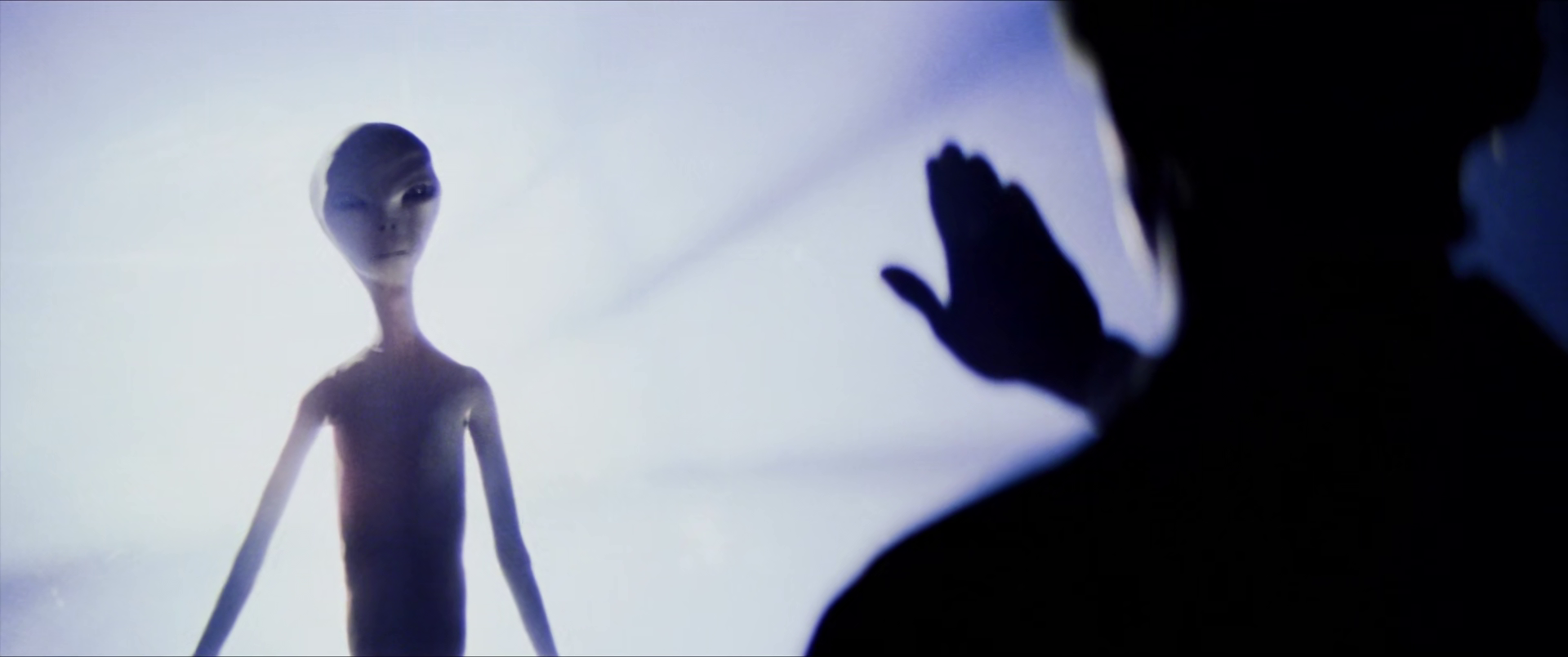
To wit: extraterrestrials will communicate to us musically (the
‘universal language’!) with five tones (or four notes) from
Western culture’s pentatonic scale (a scale upon which, apparently,
alien spaceships are physically built to incorporate) – and what’s
more, when wonder-happy scientist Lacombe (François Truffaut, a name
which, as Jean-Claude Biette merrily reminds us, rhymes with the
European pronunciation of UFO as oo-fo) decides, for no evident
reason, to marry these five tones to the (also earthbound) Kodály
gestural system, he seems to stage an ‘exchange’ with a stray
alien.
One of the most telling details of this film: in the midst of the final orgy of ‘communication’ – flashing lights and colours, pentatonic-au-go-go when they ‘switch the computer over’ to the alien mothership, long looks and heroic walks, Kubrick and Kodály – some technician ecstatically cries that nobody has any clue what is really being communicated, and that we mere humans are at the very start of a long learning process … one that we certainly will not get to see within this narrative! On this level, too, Disclosure Day loops the loop somewhat more satisfyingly: it’s another wacky semiotic circuit, from alien tongue-clicking/throat-heaving to mathematical equations to instant mental-absorption of an Other’s language (Russian or extraterrestrial, it’s the same magic), all of which leads to pristine English translation … But the new film, at least, picks up where the ‘profane’, secular responses to Close Encounters in the ‘70s and ‘80s left off, taking the Sublime Wonder of the Chariot Gods and placing that firmly within the media-electrified, material bodies of teenage TV and music fans (gloriously self-pleasuring female Beatlemaniacs in I Wanna Hold Your Hand [1978], horny boys with computers in Weird Science [1985]): Disclosure Day’s coup de grace is in its takeover of the mass media as the best way for aliens to get us to listen to them, at last. But let’s return to the core awfulness of Close Encounters. The dreaded The Fabelmans (2022) – which is even worse, in the Spielberg ‘canon’, than Close Encounters – laid out, once and for all, the roots of the director’s multi-award-winning payload of psychosexual neurosis: if Mom gets drunk, dances, and sleeps with somebody other than Pop, you are in for a life of crafting unconsciously murderous scenarios targeting horribly ‘dysfunctional’ nuclear families. Look at the Jurassic Park ‘entertainments’, it’s all there. Look at Poltergeist (1982, directed by Tobe Hooper but closely supervised by producer Spielberg), which is the horror-twin of Close Encounters. Kubrick saw and understood this entire complex dead-on, and that’s why he offered Steve the poisoned chalice of A.I.: Artificial Intelligence (2001) – the total upending of every single element in the Spielbergian edifice, which its target executed with all the guileless innocence of a Roy Neary. Roy is, in almost sense, the centre of Close Encounters. His family life is introduced to us in broad, unambiguous, unbending strokes: his kids are unbearable, screaming twits and his wife Ronnie (poor Teri Garr) is a nagging harpy. He, on the other hand, is seized with a vision – and, eventually, a mission. He stands out, well apart from the landscape of suburbia (to which Spielberg devotes a wretchedly descriptive scene). Roy is headed, come what may, for that mountain (Devils Tower) whose roots in indigenous life and mythology have been comprehensively erased by Spielberg (just as India – USA’s representative off-screen geo-political space – becomes just another fragment of child-giggly, pentatonic-paradisal communion with the skies). Ronnie
(note the masculine name) leaves her nutty husband, and takes the
brats with her. We’ll never see or hear from them again! – that’s
a shark-like off-screen space for you. Ronnie didn’t even have to
sleep with another guy to be the bad Wife in this story. Roy, on the
road, is put together with another Mom-and-kid pair (Melinda Dillon as Jillian, Cary Guffey
as Barry) who are on his exalted wavelength. Roy and Jillian share
one kiss (some commentators describe it as passionate, others as
‘comradely’) but, mind you, no
sex! That would disturb the delicate equilibrium of things
far too much for Spielberg’s tender psychosexual constitution. And
when push comes to shove, Jillian will stay on earth to mind the boy
(returned to terra firma by the aliens, along with numerous
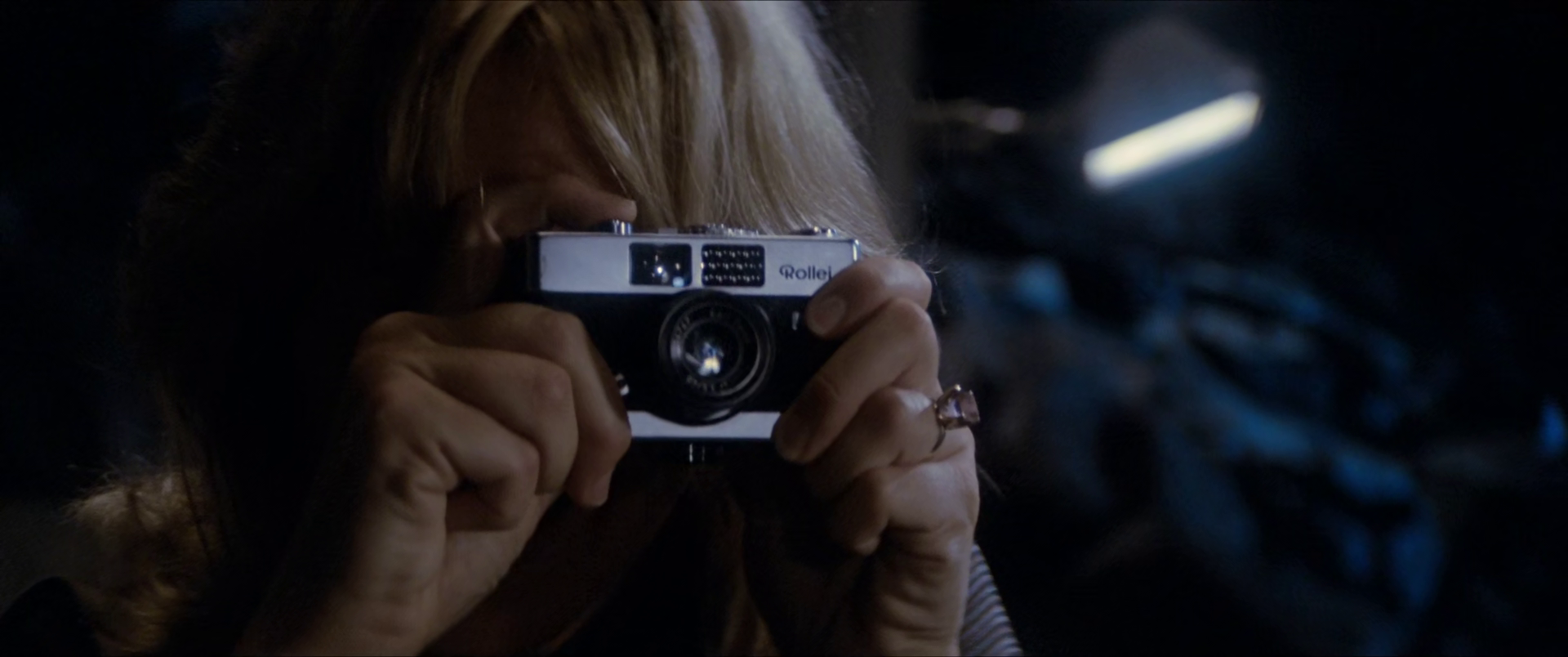
out-of-time pilots) – and, with polite, discreet pride, to snap
photos of Roy’s heavenly ascension “like a good soccer mom” (as
M. Keith Booker well describes it).
There
are so many things in this brainless movie that rankle and infuriate
me. Look at the lengthy section of the lumbering plot devoted to the
‘front of the mountain’ – the Devils Tower which Roy sculpts,
Jillian paints and another guy (another victim of off-screen space
when he falls behind in the race to the finale) draws. In truly one
of the dopiest, most idiotic scenes in cinema history (and I rarely
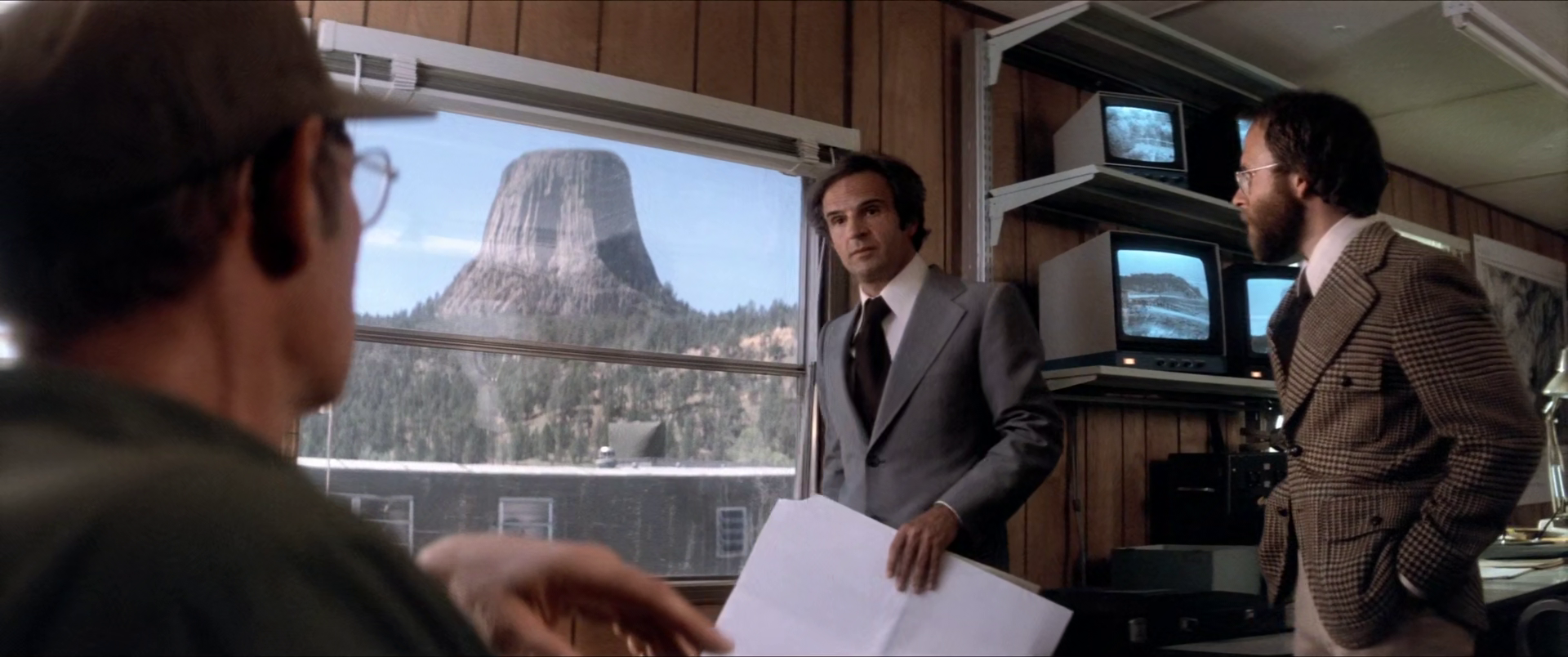
venture this sort of attack!), Lacombe earnestly argues the case that
all these ordinary-folk visions must have a meaning recorded in their trance-like drawings – and, just to ram the point
home to the military official he’s talking to, he opens
a window blind to show the mountain that is right
in front of them! Amazing revelation! As if no one in the
fiction had the nous to make this connection between a representation
and the real thing. Meanwhile – rhyming with this lunacy – Roy is
boasting to his companions that, since he sculpts in three dimensions
and they only draw a 2D front-on view, they cannot intuit, as he can,
what is on the other side of this monument!
Now, what is going on here? Mr Military is hiding the fact that he and his kind have already set up shop on the other side of the mountain – a fact that becomes plainly clear when that installation’s powerful searchlights scan the night sky? Or we are meant to believe that everyone – and I mean everyone – is fixed only on this side of the mountain, unaware that there’s not only a custom-built science station but an entire runway for alien spacecraft built back there? Hasn’t anyone ever driven, walked or flown around the back of this thing? There is, I suspect, some profoundly mad allegory of the fundamental two-dimensionality of the cinema medium at play here! I know what you’re saying to me now: it’s all clever narrative indirection, Adrian, the ‘master’ Spielberg throwing us off the trail, holding back his Big Card! But then why is Lacombe giving somebody a speech about the mountain, in the first place? Doesn’t he already know what’s back there – and its vaunted ‘meaning’? Sure as heck, the moment that ‘backstage’ is revealed, Lacombe seems to be fully in charge of proceedings – all the way to urging the aliens to ‘hurry up’ with their sound-and-light communications! Yesterday as today, Close Encounters is taken as a spectacular film about spectacle – both blinding and binding, marrying the fireworks produced to its entranced audience, on screen and off. Some (such as the late Tony Williams) detect ominous political overtones in this rapture of the assembled masses before a vague but loud ‘call’. I don’t, for my part, believe that Spielberg got that far, or that deep, in his conceptualisation process. For him, it’s ‘Disney does 2001’ wonder all the way – plot lacunae, cardboard characters, illogical scenes, and all. For some viewers, that massive override mechanism which is ‘Spielbergian cinema’ works. Not for me. MORE Spielberg: Catch Me If You Can, The Color Purple, The Lost World, Saving Private Ryan, Schindler's List, The Terminal, Munich, Hook, Empire of the Sun © Adrian Martin 16 August 2026 |