 |
 |
 |
 |


|
|
|

|
Anna
|
 |
|
Blowing in the Wind
Anna: the name of a film, and also, for a long time, the only name we had for the person who is its subject, its veritable star for three and three-quarter hours. It is a good guess that
almost no one who sees this remarkable Italian film of the 1970s will have the
slightest clue where Anna came from before appearing in it, or where she went
afterwards. Or whether she – or the child she bore during the making of the
movie – is even still alive.
Anna
has effectively disappeared into the images and sounds of this film; it absorbs
not only her name, but also something of her fragility and instability. In its
materiality, Anna reflects the type
of ‘bare life’ experienced by marginalised individuals, a life of which Italian
philosopher Giorgio Agamben has spoken so eloquently.
Anna came
about as a kind of accident. The opening scenes play catch-up, re-enacting the
encounter of co-director Massimo Sarchielli with this
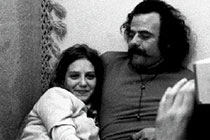
waif of the streets – pregnant, homeless, spaced-out
on drugs – in the Piazza Navona of Rome. Sarchielli, a gregarious hippie, takes her in and looks
after her, with a small crew recording some remarkably intimate scenes.
But
this is also a fiercely political work: it spends as much time on the various
protests and heated discussions going on in the Piazza as it does on the
interpersonal story.
Indoors,
Anna is the object of a fantasy-investment: everyone wants her to embody the
newborn revolution of the sub-proletriat. The camera,
accordingly, gazes at her as if she were some kind of angel, a gift – both the sign
of the real world that most people live in every day, and the hope for its
better future.
Anna,
however, remains steadfastly detached from this radical passion: her main goal
is simply to survive. And the more we observe her, the more we realise how
canny and cagey she may really be: using the filmmakers as much as they are
using her.
There
have been many fiction films dramatising the disillusionment that followed the
upheavals and breakthroughs of the 1960s, from Godard-Gorin’s Tout va bien (1972) and Eustache’s La maman et la putain (1973) to Garrel’s Regular Lovers (2005) and Assayas’ Après Mai (aka Something in the Air, 2012). But
no movie captures the nervous energy, the air of paranoia, the knotty debates of the time like Anna.
Here
you can really see the corrosive effects of what Gilles Deleuze called the ‘society of control’: cops, politicians and doctors form a dark, oppressive,
ominously interconnected backdrop to the efforts of these activists.
Time
has claimed both Sarchielli (1931-2010) and his
collaborator, co-director Alberto Grifi (1938-2007). Grifi was an artist who worked with such cross-media giants
of his time as Carmelo Bene and Gianfranco Baruchello; Sarchielli was best
known as a colourful character actor, crossing paths with everyone from Federico
Fellini and Dario Argento to Jerzy Skolimowski and Spike Lee. But they might have both remained
phantoms buried in a few Wikipedia pages if not for the digital technology that
has now returned their film to us.
Grifi and Sarchielli were themselves working at a precarious juncture
of technological change: Anna was
shot using the first open-reel video recorder available in Italy. They embraced
the new possibilities this offered for working with extended duration.
Anna could
easily have gone the way of much early video art: disintegrated, inaccessible, unviewable on contemporary players. But Grifi had a blessed intuition: he invented a machine that allowed him to transfer
video reels to 16mm. It is this footage that provided the basis for the digital
restoration by the Cineteca di Bologna.
For
once, this restoration is not a meddling, ‘clean up’ operation. The rawness of
the video material – as well as the randomness of what gets picked up by the
roving, unidirectional microphone – is respected in all its glitchy flares, drop-outs and handheld chaos. The result goes beyond Warhol, beyond Michael Snow: with its grainy
faces and half-captured voices, Anna is
a heady mixture of the abstract and the concrete, of documentary banality with
the heightened melodrama of a lived, spontaneous fiction.
And,
of all the faces caught on the fly in this film, there is one, especially
haunting, that threatens to usurp Anna from her starring position, because it
concludes the movie in a long, painful take – and, once viewed, can never be
forgotten. Vincenzo Mazza was part of the crew on Anna. He
eventually stepped out from the shadows, as it were, and entered the on-screen
story – by declaring his love for Anna and beginning a relationship with her.
But this love went wrong, and Anna eventually abandoned him.
For Vincenzo, this spelt more than a personal defeat: he
speaks of it as the end of the revolution itself, the extinguishing of an era,
the betrayal of its hopes. He thought, as he tells us in this finale, that
social change could be gentle, poetic, beautiful; instead, he has learnt only
that life is cruel and that – as they suspected before the revolution – society
is horrible, and will win out every time.
According
to research uncovered by Rachel Kushner (author of The Flamethrowers) in Artforum, Mazza himself
disappeared from the face of the earth only a few short years later: he was
killed in a street brawl by (of all people) the brother of actor Gian Maria Volonté. Like Anna
herself, Vincenzo has become a creature of grain and
pixels, a scrap of reality caught in the unruly net fashioned by Grifi and Sarchielli.
Anna is a film
devoted to all that is precarious – lives, destinies, material conditions, political
programs, artistic representations – but the miracle is that it has survived
every one of these ravages, and can seize us as directly and poignantly today
as in 1975. Probably, even more so. It is a true
masterpiece.
© Adrian Martin November 2012 |

