 |
 |
 |
 |


|
|
|

|
Hold Back the Dawn: Notes on the Position of Experimental Film in Australia (1993) |
 Amelia Rose Towers Amelia Rose Towers |
|
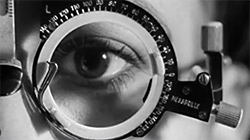
Dedicated to the memory of Nicholas Zurbrugg (1947-2001) In Scott MacDonald’s interview book A Critical Cinema 2, Laura Mulvey offers a chilling description of the supposedly cultured moviegoing audience of Britain. “Often, at experimental film screenings, when people realise what they’re going to see, they walk out at once”. (1) I have witnessed the intense hostility of the Australian arthouse crowd towards experimental work on three occasions during the early 1990s. The first was at Melbourne’s Nova – which proudly bills itself as an avant-garde cinema – during a “Critics Week” season direct from the 1993 Cannes Film Festival. Preceding the feature Combination Platter (a fey, amateurish comedy about American multiculturalism) was a remarkable short by the Austrian experimental filmmaker Martin Arnold, Passage à l’acte. It rigorously reworks a fragment from the Hollywood classic To Kill a Mockingbird (1962) on a frame-by-frame basis, jerking back and forth in order to turn isolated units of speech or noise into sonic machine gun blasts, and the smallest and most mundane gestures into a spastic choreography. I had already seen the film at an Austrian Experimental program at the Melbourne Film Festival, where it was warmly appreciated by a small and devoted audience. At the Nova, however, as soon as the spectators twigged, a few seconds in, that all they were going to get was this aggressive treatment of a stray scrap of footage, they began talking loudly, yelling obscenities at the screen, and even banging on the projection booth wall. Somebody, with truly magical thinking, speculated aloud: “It’s caught in a loop!” Someone else in earshot even plaintively inquired: “Is this a film?” When it ended twelve minutes later, there was cheering and loud expressions of relief. The second incident occurred at the Sydney Film Festival during a late night, Queer Cinema event. The program began with the latest work by acclaimed American experimental artist Su Friedrich, Rules of the Road (1993). There is only a handful of formal elements permutated in this 30-minute film: rough, observational, street shots of a certain make of car; the story of a failed gay relationship narrated by Friedrich; and, coming periodically in violently truncated bursts, bits of familiar 1980s dance songs. There was something in the specific combination of these materials – the silences, the repetition, the duration, the deliberate banality of the visuals, the quietly melodramatic tone of the narration, the fact that no song was allowed to run its proper course – that sent the crowd absolutely, cold-bloodedly crazy. Trying to concentrate on the subtlety of the film was like straining to have a conversation in a noisy nightclub of jeering hoons; and at the end, the applause was truly deafening. But they were appeased by the next film up, Barbara Hammer’s Nitrate Kisses (1992): a little bit avant-garde but still communicable to this hungry audience, by virtue of its talking-head shots of real people making declamatory statements about their gayness, and its explicit, artily photographed, footage of sexual activity. The third example happened simultaneously in various sites around Australia. The major commercial distributor, Village Roadshow, announced in 1993 that it would be reintroducing bold, innovative, Australian short films before its features – at least its high profile art-film features. Thus Neil Jordan’s crossover success The Crying Game (1992) was coupled with Jackie Farkas’ [now Wolf’s] Amelia Rose Towers (1992), which had already been well received at the Melbourne and Sydney Film Festivals, at MIMA’s Experimenta event and on SBS TV’s Eat Carpet program. Amelia Rose Towers moves in a space between classical avant-garde formalism, the various experimental-narrative movements of the 1970s and ‘80s (Yvonne Rainer, Jon Jost, Raúl Ruiz, etc.) and the kinetic pop-radicalism of music video. Its plot is obscure (because dreamlike), and the piece carries a mildly illicit frisson in its sex-and-gender imagery. But anyone from the independent film sector would have imagined that it had enough pace, mood and visual expressionism, in concentrated form, to engage the sensibility of a typical, supposedly sophisticated filmgoer. Shortly after the season began, however, Amelia Rose Towers was withdrawn. The number of angry complaints from paying punters was extraordinarily high; on a talkback segment on ABC radio, one veteran exhibitor phoned in to give evidence that he had been “forced” by Village Roadshow to screen Audrey [sic] Rose Towers, which he categorically considered “the worst film I’ve seen in 40 years”. What a record! What are we to make of these incidents in 1993? That the general moviegoing audience – even the sector that these days considers itself hip and cine-literate – is as philistine, or at least as ignorant about the history of experimental film, as it ever was? The social picture is surely depressing, not quite as simple as all that. Surveying the film culture scene, one sees the signs of a curious ambivalence towards experimental cinema: at some moments gingerly courted, at others violently expelled. An intense nervousness still hovers around the public use of the very words experimental and avant-garde, particularly within those arts organisations directly or tangentially involved with the area, where soft terms like New Art are preferred – as if the mere mention of experimentalism will either send the masses away screaming, or (more likely) raises yawns about how fundamentally passé the avant-garde is these days. When the Australian Film Institute (commendably) paid homage to the late Dušan Marek in its Australian Film Festival mid ’93, it billed him as “Animator and Painter” – but not an experimental filmmaker, which he most certainly was, and considered himself to be. The aforementioned Eat Carpet provides an illuminating case study of these diverse and contradictory feelings about experimentalism. On the one hand, it announces itself weekly as a showcase for “the bizarre, the off-beat, the experimental and the avant-garde”. On the other hand, it follows an extremely casual, smorgasbord programming policy, cool to the point of total indifference: individual titles are rarely announced in the listings of TV guides, and they simply flow by on air, one after another. Nonetheless, early in ’93, the show briefly became a media cause célèbre. Eat Carpet was publicly attacked by TVTV host Simon Townsend for screening “amateur video rubbish” – an intriguing designation of abject, experimental work. No sooner were these words printed than one of Townsend’s own co-hosts on TVTV leapt to the defence of the program – but in a predictably safe and reassuring manner, stressing the kookiness of all this weird stuff, the fact that if you don’t like any particular offering another will be along to replace it soon enough, and that it’s fun, anyhow, trying to “work out what the maker meant” by such off-beat apparitions. What of the actual material that Eat Carpet screens? Apart from a few notable exceptions (such as Su Friedrich’s demanding 1990 masterpiece Sink or Swim), the program tends to lean toward the New Art end of audiovisual experimentation (computer animation, designer-style video graphics); slightly jazzy documentary segments that (in the creaky fashion of ABC TV and radio) strive to ‘make accessible’ unfamiliar artists and their difficult work to the projected ‘average’ SBS viewer in some in pre-digested, usually glibly ‘mimetic’ (of its subject) package; and, above all, a particular brand of film-school narrative which is scarcely experimental, but merely tricked up with certain decorative, stylistic embellishments. Reviewing the film and video component of the 1989 Perspecta exhibition, Gabrielle Finnane in Photofile magazine remarked on the prevalent “curtailing of classic experimental concerns, such as inquiry into narrative and other forms of coherence, into modes of acting and performance, in favour of the professional exploitation of certain ‘established’ effects, that is, of the sign of ‘artfulness’”. (2) This kind of artiness almost always rules whenever truly experimental work is swapped for cosy, technological ‘innovation’. My own feeling about Eat Carpet, considered as a symptomatic phenomenon within film culture, is that it could have arisen only at a precise, historical conjuncture in Australia, where the idea of an avant-garde is still a little bit alluring in a vague way – i.e., one can still market something by brandishing this label, whether it fits the product or not – but also deeply suspected, and even despised. Any follower of the experimental scene has had to endure for about 15 years now – in public forums, postgraduate publications, contributions to Filmnews magazine or Melbourne’s Super Eight newsletter – definitive, murderous proclamations that the avant-garde is dead, that it passed away long ago with the last whiff of something conveniently boxed off as Modernism. As a rule, these popular propositions about why experimentalism has to be dead are about as banal as they can imaginably be. We hear that it is no longer possible to experiment because the ‘shock of the new’ has passed (trust ex-Aussie Robert Hughes on that!), and that nothing innovative can be conceivably be invented on cinema’s formal plane; we also hear that a carnivorous, postmodern culture has effortlessly absorbed all the tactics of the avant-garde. Historical note: possibly the first time the latter caveat entered discourse was when Cahiers du cinéma in 1981 disposed of Jean-François Lyotard’s idea of an experimental acinema by simply stating that, with the advent of music video, all disfigurations of the image had entered the mainstream. Twelve years later, back in Australia, Richard Lowenstein presents the twelve specially commissioned videos that go with the INXS album Full Moon, Dirty Hearts – providing a virtual compendium of every pseudo-experimental artful device in the book – as “totally avant-garde”. (3) I take two things about experimental film to be axiomatic. First, as an avant-garde practice, experimental film is not, in the first and last place, always devoted to the creation of the new (let alone the shocking); rather, it forms a tradition, a history of explorations and experiments that can always be revitalised, re-approached from new angles in both practice and critical theory. Second, experimental film works primarily at the level of material questions of cinematic form. Of course, content (however one defines this) is never extricable or separate from the workings of form; but I believe it is fair to say experimental films foreground the action of form as surely as more ordinary genres of cinematic representation foreground their elements of content. Indeed, I would suggest that it is the insistence of form over content that, in each of the three incidents cited above, caused the distress of those average arthouse spectators, prompting that deathless question: “Is this a film?” What still remains within film culture at large, however, even if the so-called historic avant-garde is considered dead like the dodo, is a romance about sustaining a mainstream culture that is diverse, independent, bold. And this is where the label of avant-garde gets roped back into programs and events: as an indispensable guarantee of an organisation’s authentic engagement with the transgressive and intractable margins of culture, at the same time yoked to a populist dream of working within the centre of the system. This is the phenomenon that Vikki Riley refers to caustically as “fairly symptomatic of the times we are in, that the marginal can be seen to be popular”, by supposedly radical ideas being presented within a mainstream form. (4) And the very film that prompted Riley’s remarks, Sally Potter’s wildly successful arthouse hit Orlando (1992), was held high at an independent cinema conference in Manchester (Britain) as an unambiguous sign that now “Hollywood is knocking on the doors of the avant-garde”. Surely no one could invent a finer romance than that. Let’s return for a moment to Queer Cinema, which has been the undisputed marketing success of film culture in 1993. As the label for a phantom movement, it is powerful and alluring because it unites prestigious crossovers successes like Orlando and The Crying Game with funkier, more confronting independent features such as Swoon (1992) and The Living End (1992), and ultimately a wide range of short, low-budget efforts including student work. For instance, Barbara Creed’s essay “Lesbian Independent Cinema and Queer Theory” – effectively a theoretical manifesto for the movement in Australia – discusses titles sweeping from Derek Jarman’s high-profile feature Edward II (1991) all the way to Leone Knight’s local, six-minute video In Loving Memory (1992). Queer Cinema – like the super-hip school of audiovisual, political collage led in America by Craig Baldwin (whose work has been picked up by Eat Carpet) – gets touted, and sometimes touts itself, not as a new and improved avant-garde, but that which supersedes and makes redundant any avant-garde. This is curious, given that experimental film has a pretty glorious gay history: Kenneth Anger, Jean Cocteau, Andy Warhol, Jean Genet, William Burroughs & Brion Gysin, Robert Beavers ... Creed writes that one of the features of works that “engage directly with queer theory debates” is the way they “deliberately confuse gender identity” through “a careful juxtaposition of images”. (5) This is a strategy that had already been taken to a sophisticated extreme in the work of Willard Maas (Geography of the Body, 1943) and Gregory Markopoulos (Twice a Man, 1963). Queer cinema (at least as it travels in Australia) tends not to cite, build upon or extend these former experiments; wiping away tradition, it starts from scratch and, more often than not, puddles around in a mere embellishment of basic S&M and/or gender-bending imagery. Indeed, it seems that all it takes is a few step-printed, colour-altered shots of a drag queen making up in front of a glitzy mirror to be deep into the supposed radicality of Queer Cinema in 1993. The romance of the marriage of the marginal and the mainstream comes with a denigration of not only traditional avant-garde film work, but also the traditional ways it has been viewed, appreciated and nurtured. Ironically, even before it had been whisked off Village Roadshow screens, Amelia Rose Towers became a central pawn in this rhetorical game. Speakers at a conference at the Museum of Contemporary Art in Sydney hailed the commercial appearance of the film as a milestone, a pointer to where we should all be heading – that is to say, a non-purist realm between commercial narrative and stylistic experimentation, such as Channel 4 is said to have ushered in after the disintegration of the British co-op-based avant-garde. (If Isaac Julien’s Young Soul Rebels [1991] is the best exemplar of such a hybrid, then god help us all.) The character of this non-purist practice is already unmistakeable: content, readability and easy audience accessibility take pride of place; while research into matters of cinematic form becomes merely an occasion for riffing loudly on select levels of artifice (sound effects, set design and performative acting). Deb Verhoeven in Agenda magazine critically compared what she considered the “passive”, safe, contemplative consumption of Farkas’ film at the 1992 Experimenta to the violently surprised, and thus more active, reception of it at the Village Roadshow city complex. (6) The implication here is that respectful, connoisseur viewing is somehow vastly less culturally dynamic and ‘useful’ than a situation in which a film amorphously ‘transgresses’ its targeted audience. Which may be enough, if experimental film is to be considered only or primarily as a moveable, ephemeral figure within a strategic game of cultural gestures and social contexts. But experimental film considered as art, expression and research demands a rather more dedicated attention to the actual, aesthetic materiality of the work in question – and a rather more delicate approach to the organisation of proper screening contexts. Experimental film finds itself in a very precarious position in 1993. The institutions of the art world galloped past it long ago; today, in this milieu’s newfound mania for a pure moving image (detestable term!) which would be an analogue for painting or sculpture – meaning, primarily, video art and multimedia installation – it often conveniently forgets that the apparently impure medium of film ever existed. A breathless bit of modern art history in a fashion magazine had Margaret Fink recounting the moment in the early ‘70s when she shocked Edmund Capon at a dinner party by leaning over to inform him that “painting is dead, video is the thing” – and she was a film producer! (7) More recently, the blockbuster exhibition Surrealism: Revolution by Night provided the ultimate expression of this sidestepping, in the near-total exclusion of experimental film from an historic art movement to which it was central. The nonsensical art-world preference for “new technological work” over “old experimental film” – though that division never needed to be set up – was reinforced at the Australian Film Commission on the day that the No Frills Fund (which supported many, very low-budget film experiments) was swapped for New Image Research, militantly seeking the cutting edge defined purely by technological criteria. Meanwhile, in the course of the 1980s, the structures that once supported what was known as the independent film sector – devoted essentially to political agit-prop, essay films, documentaries, and ragged social-realist narratives – completely collapsed, forcing its practitioners to scramble for the cultural ground won by experimentalists in that same period. Thus John Cumming, in his dubious Artlink article on the 1992 Experimenta, bullishly denigrates work in traditional avant-garde modes – formalist, subjective-lyrical, floridly expressionistic – in order to extol the tele-doco-essay film/new image research hybrid achieved by John Hughes in his Walter Benjamin project, One Way Street (1992). (8) Indeed, the entire issue of Artlink, with its clear preference for the stylish exercises of Monica Pellizzari and Tracey Moffatt over anything truly experimental (Cumming’s piece makes do as the token article on this entire area), reads like the revenge of the independent sector upon the avant-garde. If I have spoken as an unrepentant purist of experimental film in this piece, it is because I believe there is a territory that today needs defending. The cinematic avant-garde in Australia has given us Corinne Cantrill’s In This Life’s Body (1984), Arf Arf’s Thread of Voice (1993), Michael Lee’s The Mystical Rose (1976), alongside many other great and important movies. It is absolutely necessary to keep open, and under interrogation, the daily meaning of the term ‘experimental’; and it is crucial to take account of the hybrids that are forming all the time between the margins and the mainstream. But it is another thing entirely to write off experimental film and the guiding idea of an avant-garde as adventures which have long had their day. Am
I a nostalgia buff desperately trying to (as an old Hollywood
title put it) hold back the dawn? I’m just hoping that it will dawn on a few other people what a rich
tradition our experimental cinema is – and that it is a tradition
which needs preserving and cultivating in every possible way. NOTES 2. Gabrielle Finnane, “Perspecta 1989: Film and Video”, Photofile (Winter 1989), p. 32. back 3. Richard Lowenstein, quoted in Gerard Knapp, “An ‘eclectic mix’ for INXS launch”, Encore, Vol. 11 No. 16 (7-20 October 1993), p. 14. 2026 note: The entire set of these videos – subtitled The Visual Album (!) – was, in November 1993, broadcast on national TV as a special compilation ‘event’ linked by transitional material, a little in the way that DVD menus would later be devised, and likewise padded out with supplementary interviews and making-of footage. The project circulates today only in pirate DVD form, and in select, segmented bits on YouTube. back 4. Vikki Riley, “Orlando”, Filmnews (July 1993), p. 14. back 5. Barbara Creed, “Lesbian Independent Cinema and Queer Theory”, in Artlink, Vol. 13 No. 1 (March-May 1993), special issue on “Australian Film and Video” edited by Annette Blonski, p. 12. (2026 note: Of all the Australian art/film/media/culture magazines of the 1990s quoted in this essay [I wrote for them all!], only Artlink survives today; see https://www.artlink.com.au/.) back 6. Deb Verhoeven, “Identity Politics and Festivals”, Agenda, no. 30/31 (May 1993), p. 29. back 7. Quoted from memory, source unknown – possibly Australian Vogue. 2026 note: Margaret (now 93), a remarkable person whom I later had the pleasure of meeting, did continue with her own film production ventures until Candy (2006). back 8. John Cumming, “Perplexities: Experimenta 1992”, Artlink, Vol. 13 No. 1 (March-May 1993), pp. 61-62. back
© Adrian Martin November 1993 |
