 |
 |
 |
 |


|
|
|

|
The Myth of Juliet Berto |
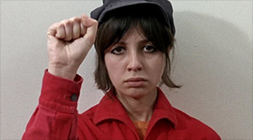 |
Inevitably, most discussions of Juliet Berto in cinema tee off with an effusion about her physical beauty. Alain Bergala describes her in (of all films) Godard’s Le Gai savoir (1969) as “resplendent with youth and health” (2). For Jessica Felrice, Berto is “piercingly adorable”. (3) Cinematographer Pierre-William Glenn, with whom she began a relationship during the filming of Out 1 (1971), describes her as being at her “most beautiful” during that period (4) – and Noël Simsolo adds that he photographed her with “an insane tenderness”. (5) Samm Deighan refers to her as (among many other things) a “fashion icon” of the 1960s. (6) Serge Toubiana recalls “her pout, her childlike mouth, her husky voice” … (7) Once that is out of the way, essays and articles on Berto usually go in two directions. The first direction is to, very briefly and casually, evoke her acting style – which tends to oscillate, in these accounts, between intense and quirky. Juliet brandishing knives and guns in Out 1; or Juliet clowning around and cracking up in Céline and Julie Go Boating (1974) – these are the contrasting images most often evoked. The Greek-American director Elia Kazan, whom she befriended during the 1970s, does not mince words: “I admired her – not that I considered her an exceptional actress, but I saw in her a truly exceptional person”. (8) The second direction – no less predictable than the beauty tag – casts her as the muse of two great auteurs of the 1960s and ‘70s: Jean-Luc Godard, with whom she made five films; and Jacques Rivette, with whom she made three (four, if we count as separate the re-edited Out 1: Spectre [1974]). Toubiana’s riff on these immortal associations is no less typical: Berto was a “bistro actress” or “café actress” (due to the preponderance of scenes featuring her in such locations), and hence an emblem of the Nouvelle Vague, the “double or feminine reversal of Jean-Pierre Léaud” – indeed, she was “Antoine Doinel as a woman, plunged into the loud years of struggle against the Vietnam War, friendship with struggling peoples, pledges for all the dispossessed.” (9) Finally, if we’re lucky, these thumbnail biographies take Berto to the point of her “journey of self-discovery” (Deighan) as a filmmaker. What I have indicated so far about the reigning discourse on Berto could, in its broad details, be applied to literally thousands of female actors of screen or stage. (10) To the end of the 1970s, Berto was known and celebrated solely as an actor (or, more often, as a pure screen presence) – despite her close, credited, co-writing involvement on Céline and Julie, and extensive improvisations in Out 1 that pushed the plot in various directions at her own prompting. (11) Simsolo, in the best and most respectful portrait-souvenir of Berto (she is the only woman who figures in his collection of personal tributes), begins not with her looks but her writing skill, telling a tale that has passed into cinephilic legend.
During the 1980s, however, Berto chose to act less, instead channeling her energies into writing and directing three feature films: Neige (1981), Cap Canaille (1983) and Havre (1986). The first two were co-directed by her partner of those years, Jean-Henri Roger (with whom she had already crossed paths on the Godard shoots of 1967 – he is hidden under the pseudonym “Jean-Jock” in the two memoirs of that period by Anne Wiazemsky [1947-2017], Une année studieuse [2012] and Un an après [2015]). (13) Berto died in January 1990, from cancer, at the age of 42. Although Havre appears to be in limbo (according to Berto’s sister Moune Jamet, the 35mm negatives are unlocatable) and Cap Canaille has yet to be re-released, Neige is a film that, in recent years, has returned to visibility and generated a renewed wave of acclaim (in its day, it won the Young Cinema Award at Cannes). For English-speaking audiences, there’s an excellent Fun City Editions DVD/Blu-ray (part of a twin-set titled “Fatal Femmes”) from 2023. Let’s retrieve the letter (of “energetic protest”) to Cahiers du cinéma, published under the title “The Sex and the Legs”, that Simsolo so admiringly evokes. Berto was 21 at the time, in 1967. “As a faithful reader of Cahiers”, it begins, “I was surprised, while consulting your ‘Dictionary of New French Cinema’ [published the previous month], to see myself interrogated, quite involuntarily, in the piece concerning M. Robbe-Grillet”. (14) She then cites that unsigned text: “No doubt the young woman of Two or Three Things I Know About Her, for whom the sentence ‘My sex is between my legs’ evokes the most violent feeling of taboo, would declare herself extremely satisfied with that product of the ‘civilisation of the ass’ named Trans-Europ-Express [1966], which she hasn’t or will not miss consuming …”. (15) Berto’s refutation follows in six numbered points.
Berto concludes with: “So, all that was just to make you suspect that everything is not so simple, that a woman is a woman, and a film is a film. No hard feelings (hmmm … ).” (17) Naturally, the Cahiers team then profusely apologises to Berto (their response is longer than her letter). It is intriguing to note that Berto’s ironic play here on Godard’s film title of 1961 returns, 10 years later, in her likely improvised dialogue for the Venezuelan production El cine soy yo (The Moving Picture Man, 1977) directed by Luis Armando Roche (1938-2021) – a happy experience that hastened her move to behind the camera – where she declares that “All actors are bisexual”, and adds: “A woman is a woman, a man is a man … that’s all shit!” In 2026, we need to deal directly with what I will call the Berto Myth – and the many distortions that, today, come with it. This myth, widely circulated, is symptomatic of the state of general cinephilic knowledge – with mistakes, gaps and questionable assumptions alongside salutary illuminations and celebrations. The
Making of a Myth She waved away questions about her childhood (born in 1947) and teenage years growing up in Grenoble (where Toubiana, a younger member of the local film club crowd there, observed her): “I don’t want to talk about that, how I started, how I met so-and-so, etc. It all seems quite absurd to me”. (18) She preferred to “abstract” her youth in the following way.
Even the exact circumstance of Godard’s inaugural casting of Berto in Two or Three Things is today shrouded in mystery; Toubiana revels in the “blurry, unclear” legend of the filmmaker plucking her out from a table of cinephiles during a trip to Grenoble in 1966, after a screening and presentation of (probably) Masculin féminin, released in March of that year. (20) There are relatively few interviews with Berto, written or filmed, and only a couple of those could be described as in-depth surveys of her career or her ideas. (21) One notices that, among interviewers, she is reluctant to divulge much to strangers, and feels more at ease talking to friends (such as Jean-Claude Moireau, Jeanne Moreau’s biographer). In filmed exchanges, she displays a habit of glaring hard at her interviewer/interlocutor after tossing out a provocative or enigmatic statement, as if awaiting an equally acute response – something that must have struck terror into the hearts of random journalists out for a quick pull-quote or sound grab. Even with casual, random fans, Berto could be scary. She boasted of turning off autograph hounds with the democratic demand: “So, why don’t you sign something for me?” And when other actors chided her for “destroying the dreams” of such fans, she responded: “Well, shit, I’ve got my own problems”. (22) Berto’s life, once settled in Paris by the start of the ‘70s, was conducted in a highly communal way right until her death. “Her amorous relationships, her family ties and her life choices – none of this was hidden”, recalls Simsolo. (23) Among her lovers was Glauber Rocha – they collaborated on Claro (1975), and had a relationship lasting several years and traversing several continents. Both Toubiana and Kazan evoke her vital energy at the centre of a swirl of family and friends, some of whom she helped financially support through her income as an actor.
Berto’s filmography as an actor is almost as difficult to access, to its full extent, as her biography. The internationalism of her choices of role (in both language and location) is striking: Switzerland, Venezuela, Italy, Belgium, Portugal, USA … Titles including Une si simple histoire (1970) by Tunisian filmmaker Abdellatif Ben Ammar, Pierre Zucca’s Roberte (1977) made in collaboration with and featuring writer-philosopher Pierre Klossowski, Jocelyne Saab’s Lebanon-set A Suspended Life (1985), and the debut feature by Bertrand Van Effenterre (whom Berto had encountered in his prior role as assistant to Alain Tanner and Rivette), Erica Minor (1974), are hard to find even if you dare to swim in the dark waters of torrented video files. And you truly do need to watch them all in order to speculate on which projects she regarded as congenial and interesting, versus those she took on simply as bread-and-butter work … while conceding that your verdict may be quite wrong. Asked about her work with evidently commercial directors including Claude Berri, Christian de Chalonge and Joseph Losey, she declared: “Each film is a different case, and I learn something every time”. (25) Her recollection of being directed by Losey in the celebrated Mr Klein (1976) offers a corrective to assumptions that she was, on screen, simply a gifted (but perhaps scarcely controlled or controllable) amateur with presence.
Many intriguing reference points of this spotty biography whizz by, allusively, in Neige. The cameo of director Robert Kramer (1939-1999), for example, with whom she had made Guns the previous year (J.-H. Roger was also in the crew of that film). Or the fact that a very striking, short man in the cast – and a familiar face in many films of the period – is Michel Berto (born Bertoliatti, 1939-1996), her husband (her birth surname being Jamet) who directed her on stage in Shakespeare’s The Tempest. There’s even a cryptic nod in the dialogue to Berto’s sole published novel, La fille aux talons d’argile (1982). There are further filmographic gaps that you will (at least at present) not learn anything about from Wikipedia in any language: most seriously, the short film Berto directed in 1974 and enthusiastically described in interviews, Babar basses’mother (a portrait of jazz musician Barre Phillips, shot by Neige’s cinematographer William Lubtchansky [1937-2010] on three simultaneous cameras); and the “kilometres of footage” she subsequently gathered in a freestyle mode with the future co-cinematographer of Shoah (1985), Jimmy Glasberg (1940-2023), that did not eventually amount to a finished work because “no one was willing to take the risk”. (27) All of this precedes the adventure of Neige – respecting, as she avowed, the more traditional path of “script, method, and advance on receipts” (28) – which is frequently misdescribed as her directorial debut. There is also a larger context to address here – one in which Berto figures at many points and levels. Much commentary on French cinema – in DVD culture, in much film criticism that travels online, and even in some academic work – depends on a handful of oft-repeated clichés, and the easy associative lines that can be drawn to fill in the ambient spaces between these clichés. It is a phenomenon that Annie Ernaux captures well in her novel The Years (2008), where people transit effortlessly from one lifestyle fad, pop philosophy or heralded Zeitgeist to another, obediently shaping their daily understanding to mediatic ‘hot takes’ and op-ed columns. (29) One subset in this particular family of clichés belongs to the designation of periods and movements in film history. Deighan, for instance, begins her DVD audio commentary on Neige by announcing her aim to look at a particular slice of French cinema which “exists in the period in-between the French New Wave and the cinéma du look”. (30) To posit those two points as the pillars of French cinema covering an approximately 30-year period is already highly reductive and damaging. Indeed, the enduring success of cinéma du look as a journalistic (and subsequently academic) catchphrase to net every supposedly surface-crazy, MTV-style filmmaker from Luc Besson and Jean-Jacques Beineix to Andrzej Żuławski and Leos Carax constitutes a bad habit we still need, collectively, to break. In the domain of of social history clichés, May ’68 surely is the biggest of them all. If you wish to inflate any film worker (director, writer, cinematographer, editor … ) with a romantic aura, link them to the riots in the streets during those heady days – no evidence is required, the merest, vaguest assertion of their sympathetic presence and/or hands-on involvement at the barricades will suffice. When, today, even the ghost of such a right-leaning, post-Hussard provocateur as Jean Eustache gets to bask in the holy embers of ’68 – simply because Jean-Pierre Léaud gives a lyrical monologue about ‘the events’ in La maman et la putain (1973) – we can gauge how much, and how often, history is being smothered in a blanket of short-cut ignorance. Berto, inevitably, gets implicated in this obfuscation. Juju has often been conjured as hanging out with Anne W. and the militant Nanterre crowd during the period around the making of La Chinoise – which is complete fiction. Apart from the fact that Wiazemsky did not militate at all, (31) Berto, in that period, was still largely a resident of Grenoble where she had grown up, and she found the revolutionary slogans she was directed to utter on screen quite opaque and silly (according, at least, to Wiazemsky, who felt the same way). In subsequent years, Berto certainly involved herself with radical politics – but (as her interviews make clear) in an instinctual rather than ideological fashion. In Latin America or the Third World, she avowed, “I wasn’t going to pick up a gun and act like a guerrilla for others …”. (32) Marching closely on the heels of May ’68 euphoria is the cliché about early ‘70s mass disillusionment on the part of radicals high and low: the reputed failure of May’s dream. Grey ‘normalisation’ returned within a matter of months, and the State regained total power! It’s certainly a dramatic account, but it seems to me that this is a version of reality almost entirely propagated by a handful of films, and by the discourse on them that endlessly repeats the dream/disillusionment duet: Godard & Gorin’s Tout va bien (1972), La maman et la putain and, much later on (in a ‘revisionist’ wave), Olivier Assayas’ Après mai (Something in the Air, 2012). (33) This is a wilfully melancholic vision that necessitates a massive blindness to so much ‘post ‘68’ that was going on in the 1970s and ‘80s at various levels of European society, including the works of such key filmmakers as Chris Marker and (in Switzerland) Alain Tanner – not to mention the rich case of Italy, with its own ‘68 milestone of Bologna followed up by intense years of the Autonomia movement, something you will hardly see reflected in even the best films by despairing leftists including Bernardo Bertolucci, Nanni Moretti and Marco Bellocchio. Berto has, in the 2020s, been embraced by the connoisseur-brigade for ‘cult cinema’. How does her career as both actor and director get squeezed into that picture? As in film criticism of every stripe, an associative game is played: certain names, certain genres, certain film style markers pop out of the annotated filmography, lighting up and forming an attractive diagram to the necessarily biased observer. A ‘niche’ slice of cinema is thereby constituted. I perform this largely unconscious activity no less than anyone else: around Berto, I underline the presence (fleeting or lasting) of Kramer, Zucca, Rocha, Tanner, Ivens – rather than Chalonge, Berri and Francis Leroi – because I consider that specific constellation significant and productive to study. For others, the diagram is evidently different: since (for instance) Leroi went on to cult fame at the helm of many erotica productions (including numerous Emmanuelle movies), his Ciné-girl (aka Willing, 1969) with Berto must constitute, ipso facto, an especially alluring talisman for the cult-film connoisseur. One cinephile’s Venn diagram can (and often does) overlap with another’s: both might zero in, for example, on Berto’s participation in Serge Bard’s Destroy Yourselves (1968) and the intriguing cultural place of the Zanzibar group of artist-filmmakers. (34) But associative leap-frogging can also easily lead one astray. The
Breaking of a Myth The historical moment that makes the most sense of Neige and its significant contemporaries is the electoral triumph of the French Socialist Left in April and May of 1981, when François Mitterand replaced Valéry Giscard d’Estaing as President. This event has not passed into the fund of commonplaces about French cinema – and it would upset the easy, romantic myth of the once-and-for-all ‘failed revolution’ of ’68. But the gap between 1968 and 1981 is a large one in terms of lived history, as well as cultural and political trends. In fact, you can read dozens of English-language reviews of films from that specific, early ‘80s period – Rivette’s Pont du nord (1981), Marie-Claude Treilhou’s Simone Barbès, ou la vérité (1980), Patrick Grandperret’s Court circuits (1981), Godard’s short Changer d’image (1982) – and turn up not one reference to this rather important political event of the 1981 election (whatever we make of its subsequent outcome; Jean-François Lyotard began a 1982 essay with the curt pronouncement: “The socialists’ victory did not thrill me”). (35) Jean-Henri Roger, looking back on Neige in 2013, is perfectly plain and clear about this context informing the work achieved by Berto and himself. When asked by Laurent Laborie, “Your film was released in May 1981. Did the political context have an influence on the film?”, Roger replies.
There’s a specific matter of culture – and cultural policy – worth adding to this. In a brief but insightful survey of Berto’s career, Vincent Raymond refers to the music of Neige (credited to François Bréant and Bernard Lavilliers) and the recollection of a particular time and sensibility that it prompts. Rather than Serge Gainsbourg’s chart-busting turn to reggae in 1978 as a possible influence on Berto’s film – an influence that was probably hard to avoid in that period – Raymond’s speculation has both a finer grain and a wider reach: “We can assume that she [i.e., Berto] regarded with interest what was going on in the Cold Wave and Culture Novö movements” that entered French post-punk music from roughly 1978 to 1988, since these sounds characterised “the start of the Lang years that will, in a joyous ‘melting pot’, soon catalyse a French Movida – alas, one that was short-lived …”. (37) The multiple references in this passage are dense: to Jack Lang, socialist Minister of Culture between 1981 and 1986, then 1988 and 1993; to the Movida Madrileña that arose during Spain’s post-Franco transition, an often outrageous, profoundly queer movement from which Pedro Almodóvar (among others) emerged as both filmmaker and singer; and to several, intertwined music styles (tending to deadpan minimalism) that have re-entered discussions of popular music (and its cycles of revival) only in the past 15 years. There is much to explore here. Raymond points to the social phenomenon of the melting-pot of many cultures – which is, in many respects, they central subject of Neige – and its intersection with an explosion of new, diverse sexual identities (as in the Movida). One can be too cautious, in our identity-politics days, about simply projecting the 2020s conceptions of queer and trans sexuality backwards onto a film of 1981. But such caution is excessive because this complex early ‘80s moment in France already contains an outlook and sensibility that we can immediately recognise and embrace today (some shifts in emphasis and terminology notwithstanding). This is one of the reasons why Treilhou’s extraordinary Simone Barbès has been rediscovered in recent years, and championed by critics including Camille Nevers (journalistic pseudonym of the filmmaker Sandrine Rinaldi). (38) This reference, in turn, opens up one of the filmic contexts that, in trying to form an adequate account of Neige, helps to fill that yawning critical void in-between the Nouvelle Vague and the cinéma du look. I refer to the vast archive of material generated by Paul Vecchiali’s production company Diagonale, which operated between 1972 and his death in 2023. This was a low-budget mode of production, and a body of work, that has gone largely undiscussed in English-language criticism and scholarship (Diagonale isn’t even mentioned on the sparse English-language Wikipedia page for Vecchiali!) – and has (so far) almost entirely bypassed the voracious, completist eyes of the current movie-cultists, since it rarely plays the film-genre game by any of its major rules. (39) Suffice to say, however, that the œuvres of Treilhou, Simoslo, Jean-Claude Biette, Jean-Claude Guiguet, Adolfo Arrieta, Gérard Frot-Coutaz, and Vecchiali himself – as well as the torch-bearers of a later generation (associated for a time with the magazine La lettre du cinéma) – offer untold riches for the analysis of queer cinema … and, indeed, cinema tout court. In the annals of recent film criticism, I am aware of only one English-language piece, by Oscar Pederson, that connects Neige and Diagonale within the French cultural context of the early ‘80s.
Pederson conjures a wide and generous network of films from this loose formula: everything from Rivette, Stévénin (as director) and Samuel Fuller (in his French period), to Kramer’s amazing À toute allure (1982), Danielle Jaeggi’s La fille de Prague avec un sac très lourd (1979) and Raúl Ruiz’s Le jeu de l’oie (Snakes and Ladders, 1980). And absolutely no cinéma du look in sight! With this slew of titles arise new considerations of what we today like to call the infrastructure of filmmaking: independent units like Richard Copans’ Films d’ici, opportunities offered in the ‘80s by French television, modest but international co-production arrangements (which have today become the norm for ‘art films’ everywhere). Hopefully, Whit Strub’s forthcoming book on Kramer will help illuminate some of these connections. (41) The
beginning of the 1980s in French cinema was not (as it is so often
presented) a wasteland, a funeral pyre, or a sub-pop-genre crawl. It
is a rich period of innovation: a quiet revolution. Juliet Berto
found her rightful place as creator, catalyst and actor in that
milieu. NOTES 2. Alain Bergala, “Le Gai savoir”, in “Spécial Godard. Trente ans depuis”, Cahiers du cinéma hors-série (August 1991), p. 119. back 3. Jessica Felrice, “Juliet Berto: Adorable Offender”, Neige DVD booklet (Fun City Editions, 2023), p. 5. back 4. Pierre-William Glenn, interview in the documentary The Mysteries of Paris, included on the Arrow and Criterion DVD editions of Out 1. back 5. Noël Simsolo, Portraits-souvenirs de cinéma (Paris: Éditions Hors Commerce, 2007), p. 35. This very insightful and revealing book seems to be little-known, as it is rarely cited by any scholar or critic of French cinema. A collection of tributes to people Simoslo knew personally, its discrete chapters overlap in elegant ways – in this case, the pages on Berto intersect with those devoted to Glauber Rocha. back 6. Samm Deighan, audio commentary on Neige (Fun City Editions DVD). All subsequent quotations from Deighan have been transcribed from this source. back 7. Serge Toubiana, “Farewell Juliet”, Cahiers du cinéma, no. 428 (February 1990), p. 57. back 8. Elia Kazan, “Souvenir de Juliet Berto”, Positif, no. 351 (May 1990), p. 53. back 9. Toubiana, “Farewell Juliet”, pp. 56-57. back 10. For a comparable case, see Cristina Álvarez López & Adrian Martin, “Nothing of the Sort: Barbara Loden’s Wanda (1970)”, Cinema Comparat/ive Cinema, Vol. IV No. 8 (2015). back 11. Jordan, “I. Céline”, pp. 22-24. back 12. Simsolo, Portraits-souvenirs, p. 35. back 13. Both volumes of Wiazemsky’s memoirs are published by Gallimard. (They in fact form the final two-thirds of a trilogy that starts with Jeune fille in 2007, recounting her adventures on the set of Robert Bresson’s Au hasard Balthazar [1966].) It’s worth knowing that, likewise, Godard’s collaborator Jean-Pierre Gorin is re-named by Wiazemsky as “Charles”. A useful summary of these books is provided by Max Nelson, “Wiazemsky and Godard: One Long Deconstruction”, Salmagundi, no. 199 (2018), pp. 33-43. back 14. Juliet Berto, “Le sexe et les jambes”, Cahiers du cinéma, no. 188 (March 1967), p. 4. back 15. Anon., “Robbe-Grillet, Alain”, Cahiers du cinéma, no. 187 (February 1967), pp. 62-63. back 16. Berto, “Le sexe”, p. 4. back 17. Ibid. back 18. Jean-Claude Moireau, “Juliet Berto”, Cinéma, no. 314 (November 1985), p. 17. back 19. Ibid. back 20. Toubiana, “Farewell Juliet”, p. 56. De Baecque, in his Godard. Biographie (Paris: Pluriel, 2010), adds the juicy detail that Berto and Godard had a brief affair (presumably in ’66), but I haven’t seen that confirmed elsewhere. Wiazemsky, for her part, relates how Berto left an intimate letter for Godard each day on the set of La Chinoise (which was, unbeknownst to most cast and crew, his and Wiazemsky’s shared love nest), until Juju was fully informed of the situation and gallantly desisted in her amorous quest – thus kicking off a long, complicit friendship between the two women (see Wiazemsky, Une année studieuse). back 21. The best interviews, in my opinion, are by Jordan (see note 1) and Moireau (see note 18). back 22. Jordan, “I. Céline”, p. 21. back 23. Simsolo, Portraits-souvenirs, p. 40. back 24. Toubiana, “Farewell Juliet”, p. 57. back 25. Moireau, “Juliet Berto”, p. 20. back 26. Ibid. back 27. Ibid., p. 21. back 28. Ibid., p. 22. back 29. Annie Ernaux, The Years (Seven Stories Press, 2017). back 30. The story of cinéma du look as a popular catchphrase begins with Raphaël Bassan’s 1989 La Revue du cinéma magazine article “Three Neo-Baroque Directors”, which was subsequently translated and placed at the head of The Films of Luc Besson: Master of Spectacle (Manchester University Press, 2009), edited by Susan Hayward and Phil Powrie. Guy Austin’s pedagogically-slanted Contemporary French Cinema: An Introduction (Manchester University Press, 1996) also served to reinforce the Bassan line – not to mention the innumerable journalistic handballings of the term in Sight and Sound articles and other populist sources. In his otherwise valuable The Legacy of the New Wave in French Cinema (2019), Douglas Morrey again circumscribes a cinéma du look that has only three practitioners – the usual suspects of Besson, Beineix and Carax. In their Leos Carax (Manchester University Press, 2003), Fergus Daly and Garin Dowd are at pains to (rightly, in my view) dissociate the last-named of that trio from the brand-label – by suggesting a different genealogy of influences, a model I adopt and extend here in my discussion of Neige. back 31. Curiously, de Baecque in his Godard. Biographie, whilst extensively quoting Wiazemsky’s memoirs and her most candid interviews, also lazily recycles the myth of her ‘student radicality’ – sometimes, contradictorily, within the same paragraph. For example: “Both the student and the filmmaker were fascinated by this ambience of guerrilla politics, and above all by the teachings dispensed by a wonderful team of professors: Francis Jeanson, Paul Ricœur, Emmanuel Levinas, Henri Lefebvre, Louis Marin, the sociologist Michel Crozier, and the historians René Raymond and Pierre Goubert” (p. 346). But Wiazemsky, by her own account, rarely attended classes, dropped out before first-year exams, and generally disdained the political culture of Vincennes (she declares the student body to be vulgar, unwashed and badly groomed!). The only one of the names which de Baecque lists that Wiazemsky ever cites in her autobiography is Jeanson (her interlocutor in the famous train sequence of La Chinoise), whom she knew before enrolling in Nanterre, and of whom she approved precisely because he represented, to her, a rational, moderate, cultured position far removed from the then-modish “guerrilla politics”. back 32. In a fascinating 2021 interview, philosopher Mehdi Belhaj Kacem (who acted in Garrel’s Sauvage Innocence, 2001) reacts in shock to Daniel Tutt’s question (referencing the generation of ‘68) “How does one go about finding and cultivating a radical spirit in today’s age?”:
And since the Kacem/Garrel association has popped up: the case of the latter’s Les amants réguliers (2005), a ‘68 memoir that is certainly melancholic, is, I feel, more specific. The film is less about collective political decline than the derailment of a particular bohemian/subcultural lifestyle – via its descent into drug abuse, economic precarity, and a criminality that was often brutally persecuted (in the form of, among other institutional tactics, psychiatric internment). That, however, did not stop many commentators seeing in the film a generalised mirror of the vaunted ‘failure of ‘68’. back 33. Moireau, “Juliet Berto”, p. 20. back 34. See Sally Shafto, The Zanzibar Films and the Dandies of May 1968 (Paris Expérimental, 2007). back 35. Jean-François Lyotard, “The Differend” (1982), in Bill Readings (ed.), Political Writings (Minneapolis: University of Minnesota Press, 1993), p. 8. back 36. Laurent Laborie, “Neige à Barbès avec Jean-Henri Roger”, Paris-Louxor, 16 January 2013. back 37. Vincent Raymond, “Juliet Berto, l’inoubliable et mystérieuse icône”, Le petit bulletin (Lyon), 11 January 2022. back 38. Camille Nevers, “‘Un petit case de conscience’ de haut vol”, Libération, 3 December 2022. back 39. For good introductions, see Patrick Preziosi, “Notebook Primer: Diagonale et Co.”, MUBI Notebook, 16 December 2021; Dmitry Martov, “The Family Bozon”, n + 1, 23 February 2011; and Axelle Ropert, “Diagonale and Us”, Screen Slate, 7 September 2023. It should also be noted that several of Vecchiali’s own films, at least, have become available from English-language DVD distributors since 2024: the “unconventional French giallo” (!) The Strangler (1972) from Altered Innocence, Don’t Change Hands (1975) from Severin, and Rosa la Rose, fille publique (1985) from Radiance. back 40. Oscar Pedersen, “Streets of Parisian Fiction: The Adventurers of ‘80s Cinema”, Sabzian, 5 June 2024. back 41. Whitney Strub, Films That Explode Like Grenades: Robert Kramer and the Search for a Radical Cinema (University of Chicago Press, 2026). back
|
