 |
 |
 |
 |


|
|
|

|
Man on Earth
|
 |
|
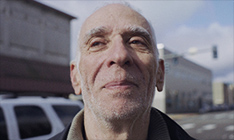
Enter My House Justified Amiel Courtin-Wilson’s documentary Man on Earth is remarkable. One would be tempted to describe it as confronting, were it not so gentle and lyrical in its approach. The potentially confronting element for some viewers lays in its essential subject matter: the film, shot in Seattle (Washington State, USA), follows the final week in 2019 of the life of Bob Rosenzweig as he readies himself for assisted suicide. From its opening moments, Man on Earth refuses any recourse to easy sentimentality. Bob himself, aged 65, sets this tone: visibly suffering all the pain and frustration bequeathed to his bodily functions by Parkinson’s Disease, he stares right down the barrel of the digital Arri Mini camera lens and gives us his twin mottos: “Fuck it” and “It is what it is”. Which is to say: he accepts the fact of his condition, but he is not willing to hide or underplay his volatile emotions in the face of that. With those around him – especially his adult son, Jesse, who serves as his principal carer – Bob can be demanding, brusque, difficult, suddenly distant and uncommunicative. His mood can alter in a split-second. Yet Bob is also driven by an overwhelming need to affirm his love for the central people in his life, and to share – through whatever means possible – precious moments with them during these final days “on earth”. Man on Earth is not an explicitly religious or spiritual film, and is largely silent on the question of any possible afterlife. Its aim is to let us closely observe, and become emotionally, empathetically involved with, Bob’s death as a material, earthly experience. It is the record of a peaceful and fully chosen ‘passing away’ from mortal consciousness. Nonetheless, I found myself recalling, at its conclusion, the line from Sam Peckinpah’s classic, autumnal Western Ride the High Country (1962) that is savoured by cinephiles of several generations: “All I want is to enter my house justified”. This mention of one of cinema’s masterpieces prompts a long detour I will dare to take in an attempt to weigh the full measure of Man on Earth’s achievement within a broad context of cultural attitudes to, and cinematic depictions of, death and dying. The writing of this essay about a film on the topic of assisted suicide happened to coincide with a widely publicised instance of this very practice: the celebrated Swiss-French filmmaker Jean-Luc Godard chose this means of dying at the age of 91, and his wish was carried out at home in Rolle (Switzerland) on 13 September 2022. Public reactions (on social media and elsewhere) to this particular aspect of Godard’s biography ran the predictable gamut from philosophical admiration to angry bewilderment. Some referred to the fact that suicide had figured prominently for the fictional characters in his films; others pointed to the director’s own statements, scattered over the preceding decade, that he was carefully researching and considering assisted suicide as an option. The official statement from a lawyer, as it initially came to us in slightly mangled English translation, declared that Godard felt “exhausted” (epuisé, worn out, at the end of his rope), his body was “tired” (fatigué), and that he “could no longer live normally, due to various pathologies”. (1) Further intimate details of his physical condition were not forthcoming, although many people steeped in Godardian lore know that he had almost died on two previous occasions: when he was involved in a serious road accident in 1971, and when he suffered a heart attack in 2016. Above all, Godard had made clear, both to occasional interviewers and to those closest to him, that he did not want to spend an unpredictable number of years in a state of bodily and/or mental deterioration, simply waiting to expire, and becoming increasingly dependent on others; he wished to take control of the dying process while it was still possible for him to do so. The same self-determination applies to Bob Rosenzweig. Beyond the specific case of Godard, it is easy to confuse terms and issues that are intricately interrelated, but also subtly distinct. As UK law defines it, euthanasia is “the act of deliberately ending a person’s life to relieve suffering”; while assisted suicide is “the act of deliberately assisting another person to kill themselves”. (2) The Maxim Institute of New Zealand makes a related but finer distinction: Broadly, euthanasia describes the situation where the person who is asking for assistance to die has someone else take the action that leads to their unnatural death (like injecting a lethal drug), and assisted suicide is when the person is prescribed drugs that they must take themselves in order to die. (3) The latter scenario is what we witness in Man on Earth (and is, presumably, also the path that Godard took). Both in Switzerland and in Washington State (and also in parts of Australia), properly medically supervised assisted suicide is legal; in many countries, it is not. This ‘criminal’ aura that has attached itself to the practice of assisted suicide is among the factors that make it a nervous, anxious, somewhat hidden topic in public discussion. Another decisive factor is the fundamental discomfort many feel in talking about – letting alone personally facing – the prospect of imminent death (in oneself or others), and/or the all-pervasive, inescapable fact of human mortality. As Bob Dylan put it so well in “It’s Alright Ma (I’m Only Bleeding)”: “He who is not busy being born is busy dying”. A fascinating, incidental example served as a true punctum for me in this regard: in his DVD audio commentary laid over the film 3 Women (1977, Criterion edition), Robert Altman – a filmmaker whose work is veritably stuffed with scenes of death and ambient intimations of mortality – expressed anger and exasperation over the untimely passing of his close collaborator, Tommy Thompson: “He just stepped off the earth!”, seethes Altman, as if it were a wilful, deliberate, provocative act on his friend’s part. Above all, there is short-circuiting confusion in the collective imagination between suicide – the taking of one’s own life – and assisted suicide. Countless dramas (and even a vein of black comedy) have accustomed us to consider suicide as, variously, a lonely, desperate, anguished, impulsive, melancholic, end-of-the-road, out-of-control act. In my own archive of writings, I discovered an unpublished, unfinished (and entirely forgotten by me), handwritten draft from 1986 titled “Suicide and Film”. Suicide in a film is always a point of intersection, a nodal point between the interior/personal and the exterior/social. This intersection is also a pressure point, an unbearable point of friction between the two realms. Suicide, in cinema, always takes place in response to a situation that has been graphically and dynamically sketched. Suicide’s mode is that of escape, crisis, tension, disavowal, withdrawal, release … Despite my now slightly embarrassing, youthful certainties as to what suicide, in film or reality, “always” is, the fact is that the many different types and situations of suicide open a flood of conflicting interpretations. Suicide can be considered heroic, or sad; an individual sickness, or the symptom of a wider, social crisis. Sometimes it is taken, in an unsympathetic way, as the indication of a moral failing or personal weakness in the one who commits it. Just as often, it is glorified as a near-mythic existentialist act, as is the case in the reception of the suicide of philosopher-activist Guy Debord in 1994, or writer René Crevel in 1935. Philippe Garrel’s films, in which suicide often figures, canvas all these positions, as does a literary milestone, Pierre Drieu La Rochelle’s The Fire Within (1931), adapted for the screen by both Louis Malle and Joachim Trier. This same latitude of interpretation is equally evident in the ways that suicide appears in Godard’s own work: the ambiguous, off-screen death of Paul (Jean-Pierre Léaud) in Masculin féminin (1966), situated between its two final scenes, very possibly a suicide, is associated with the character’s personal confusion and despair in love; while the recounting of the fate of a female “suicide bomber” in Notre musique (2005) registers as a political parable. The relation of suicide to variegated states of depression is often poorly understood – and depression itself is open to both individual and social diagnoses. One need only survey the responses to filmmaker Chantal Akerman’s suicide in 2015, “after many years of suffering manic-depression” (4) and frequently in a state of agitated anger over the state of the world. Or read Franco ‘Bifo’ Berardi’s heartbreaking commentary on the suicide of his “comrade”, the writer Mark Fisher, who “took a leap into the dimension of nothingness”. Mark Fisher explained his suffering in direct relationship with the way he perceived himself in the other’s sight, and he said he felt “good for nothing”. We are hundreds of millions who, like him, are forced to feel good for nothing because we cannot comply with the competitive demands in exchange for which our identity is socially certified. […] In order to explain what depression is we need to comprehend impotence, namely the incapability of actualising a potentiality that, although inscribed in our social and erotic being, does not become effective. (5) Bifo stresses the vital importance of “hugging, caressing, solidarity” in any worthwhile attempt to interrelate the personal and political spheres of understanding and experience. “The openness of receiving a caress,” he writes, “is not only the condition for individual happiness, but also that of rebellion, of collective autonomy and of emancipation from salaried work.” (6) We can posit, extrapolating from these remarks, the larger politics of Amiel Courtin-Wilson’s cinema, from its beginnings in Chasing Buddha (1999) through to Bastardy (2008), Hail (2011) and The Silent Eye (2016): he and his collaborators give us, across many different stylistic forms, a similar conjunction of social marginality, creativity, deep and compassionate human connection, and a cry for collective social justice. Man on Earth takes its rightful place in that lineage. Many books could be filled – and, to an extent, have already been filled – exploring the topic of death and cinema. Once you elect to look at the theme closely, necessarily excluding all other subjects from your purview, it is literally everywhere. So many movies have a death at their dramatic centre; so many more indiscriminately spray dead bodies everywhere, in a merry free-for-all of continuous slaughter – for a post-Tarantino example of this trend, see the Korean action-thriller, Carter (2022). Death is also (as many have argued) an inherent aspect of cinema as a medium, in a way that it is not true of novels, paintings, or even theatre. Cinema, according to the famous aphorism coined by Jean Cocteau records “death at work” or, more exactly, the constant process of dying – i.e., it captures and imprints the passing of time. This is especially so in relation to the human factor – the visible ageing of actors from one role to the next. Think, for example, of the enormous poignancy of seeing so many members of David Lynch’s original Twin Peaks cast 35 years later in Twin Peaks: The Return (2017). Or François Truffaut, who pursued Cocteau’s theme through his work with Jean-Pierre Léaud as on-screen alter ego – not just in the Antoine Doinel series from 1959 to 1979, but particularly in Two English Girls (1971), where the character played by Léaud, in a sudden ellipse far ahead in years, confronts his aged reflection. Leáud was, in turn, chosen after Truffaut’s death by other directors who continued the reflexive theme, especially Tsai Ming-liang in the aptly titled What Time Is It There? (2001) and Nobuhiro Suwa in The Lion Sleeps Tonight (2017). What kind of film is Man on Earth, exactly? To what can it be fruitfully compared? It departs from conventional documentary methods in choosing to stick, essentially, with its subject in the last week of his life. Where other filmmakers might have made more of the contrast between the Bob who has Parkinson’s and the Bob who once designed bathrooms for music celebrities such as Elton John, Courtin-Wilson and his team provide only a very discreet “archival” component. It is not a film of nostalgic reminiscence, but of living in and through the moment. Likewise, the filmmakers choose to show in images, or include on the soundtrack, extremely little of their own presence. This not a documentary intent on showing the whole process of interaction and negotiation between a director and his or her real-life protagonist, such as Nick Broomfield (Heidi Fleiss: Hollywood Madam, 1995) or Michael Moore (Bowling for Columbine, 2002) often deliver. Such strategic withholding creates certain, unstressed questions and mysteries in Man on Earth: for example, one can suspect from the closing scenes that not all members of Bob’s family were comfortable with being filmed, and thus are allowed to remain shadowy, unidentified figures. The net result of all these decisions is that Man on Earth deliberately downplays conventional documentary exposition. The overriding impression is that we are simply ‘with’ Bob as privileged, intimate observers. Courtin-Wilson’s response to our culture’s general defensiveness and evasiveness in the face of death is that, quite simply, we must look right at it and bear testamentary witness – without Gothic horror, without undue ‘projection’ of any kind. This closeness of the cinematic look recalls Frederick Wiseman’s little-screened, near-six-hour documentary masterpiece filmed in a hospital, Near Death (1989). Is Man on Earth, then, an instance of so-called ‘fly on the wall’, observational filmmaking, of that much-mystified documentary genre known as cinéma-vérité? To an extent, yes. But it is also a finely edited (by Peter Sciberras) and modulated piece, elbowing out space and time within its unfolding structure to include poetic shots of the house and environment around Bob (the cinematography is by Jacqueline Fitzgerald), and an atmospheric, non-insistent soundtrack combining the talents of composer Nicholas Becker and sound designer/mixer Robert MacKenzie. On this level, it invites comparison with Silverlake Life: The View from Here (1993), a film constructed by Peter Friedman from Tom Joslin’s video diary as he died from AIDS-related illness. Does Courtin-Wilson sensationalise or in any way exploit Rosenzweig’s death by turning into a screen spectacle for our consumption, our ‘enjoyment’? Is there a ghoulish aspect to this project, the type of morbid ambience that suffuses the portrait that Wim Wenders and Nicholas Ray made of the latter in his last months, Lightning Over Water (1980)? There are doubtless some viewers and commentators who will respond negatively to Courtin-Wilson’s film in that way. But there are, to say the least, mitigating factors at play. First, Bob contacted the filmmakers and invited them to document his dying. Second (as the film’s publicity materials inform us), he was well aware that there was a suspense factor inherent in the material, with various potential twists and intensifications of emotion along the way; such ‘entertainment’ was not something that he ruled out of bounds or inappropriate. Let’s rephrase the potential objection to Man on Earth in another way: does it turn Bob’s last days into too much of a coherent story, something that feels contrived or manipulated in its final shaping, editing and post-production treatment? Again, I do not believe this would be a fair or accurate critique. As I watched the film for the first time, I did wonder if Bob’s journey had been rendered by the filmmakers in an overly resolved, neatly tied-up way. I was reminded, in this regard, of the many documentary films in which the director (or the principal on-screen subject) seeks out their perhaps long-absent parents in hope of a full-blown, purging catharsis of ultimate acknowledgement, forgiveness and mutual understanding, and all that in front of a rolling camera – a goal that Bob, too, seeks with his family members. Personal documentaries including Sarah Polley’s Stories We Tell (2012) and Mark Wexler’s Tell Them Who You Are (2005) sometimes end up revealing the brutal limits of a dream of reconciliation and catharsis. For, when the parental figure is already dead or absent or (it happens) almost entirely unforthcoming or uncooperative, how can such catharsis occur, except through a sentimental forcing of the quest for hidden truth? This is exactly that the critique that Haskell Wexler makes of his son as the latter attempts to bring about a ‘real time’ reconciliation on screen. In some sense, any sympathetic treatment of an individual’s choice as to how they will die – whether in documentary or fiction – can be said to harbour a particular fantasy, which is also an understandable, human wish: death, as we all know, is something that very often escapes our control altogether. It may be sudden, tragic, irreversible, inexplicable. Trying to ‘get on top’ of that – to reverse it, in wishful fantasy – can so easily come across, in a screen testament, as a particularly aggressive (and, it must be said, especially masculine) assertion of impossible privilege. Man on Earth, however, earns and justifies its right – through the unflinching and empathetic character of its gaze, and the complex mood it conjures – to a little piece of this validly Utopian fantasy of control and self-justification. Man on Earth would make a great double-bill with another Australian documentary that is, sadly, too little known or heralded: Janine Hocking’s Mademoiselle and the Doctor (2003). It, too, is about a case of assisted suicide. One half of its interwoven trajectory shows the efforts of Dr Philip Nitschke to defend, publicise and practice “voluntary euthanasia” (another term for assisted suicide). The other half offers a portrait of 79-year-old Lisette Nigot in Perth. Like Godard, Nigot has firmly decided to shuffle off the mortal coil while she still possesses all her faculties. In a splendid moment, she refutes the unsubtle insinuation of her interviewer: “Do I look depressed?” The film slowly and masterfully builds to the encounter of these two people, Nigot and Nitschke, and its aftermath. When first screened on ABC TV (which helped produce it) in Australia, three scenes of Mademoiselle and the Doctor (in which suicide methods are demonstrated) were suppressed for broadcast. An ABC representative informed Nitschke that the reasons informing the in-house censorship decision were “moral” rather than “legal” in nature. (7) When I wrote a review of the unexpurgated cinema version in late 2004, I remarked: Mademoiselle and the Doctor is a beautifully constructed piece of cinema, with a cumulative emotional effect that is rare in Australian film. I can only speculate that the reason it has not, to date, been more grandly embraced and acclaimed by the local industry is because of the intense discomfort-factor inherent in the subject it broaches, and its refusal to indulge in facile moralising. But great films invite us to ponder uncomfortable thoughts, and take us to places where, on first blush, we might rather not go. By this criterion, Mademoiselle and the Doctor is indeed a great Australian film. Man
on Earth is very different in tone and
style to Mademoiselle and the Doctor,
but I could use almost exactly the same words today to hail its value
and significance. NOTES 2. National Heath Service (UK). back 3. The Maxim Institute, “Frequently Asked Questions #1: What is the Difference Between Euthanasia and Assisted Suicide?”. The site contains several clear and useful articles on these topics and their relation to legislation in New Zealand. back 4. Jon Davies, “Every Home a Heartache: Chantal Akerman”, C Mag, 1 June 2016. back 5. Franco ‘Bifo’ Berardi, “‘How Do We Explain Depression to Ourselves?’ Bifo Remembers Mark Fisher”, Novara Media, 4 February 2017. back 6. Ibid. back 7. See the documentation of this controversy from the time at the website of Exit Australia (of which Nitschke was then Director). back © Adrian Martin October 2022 |


