 |
 |
 |
 |


|
|
|

|
Kamikaze
Taxi
|
 |
|
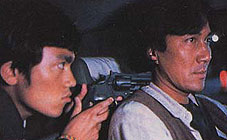
Like Prisoner of the Mountains (1996), Kamikaze Taxi throws two starkly different characters into a situation where they must live and work closely together, or die. It takes quite a while for the audience to get a grasp on these two: the often brutish yakuza employee Tatsuo (Kazuya Takahashi), with his punkish impulses and casual nihilism, and the quietly noble and resourceful taxi driver Kantake (Koji Yakusho), harbouring a traumatic past as a Japanese-Peruvian. By sheer chance, Kantake has snared a well-paying job as Tatsuo's chauffeur as he moves in and out of Tokyo, exacting bloody revenge on his former mob bosses. Tatsuo's career in the criminal world has been short, nasty and disastrous – and he has made himself a doomed exile by robbing the personal stash of a high-ranking politician. This is a long (149 minute) film that takes its sweet time on most points. Its rhythm, and the exquisitely slow burn this affords, is part of its compelling, sinuous charm. Writer-director Masato Harada concocts a surprising mix of genres, each treated in an unusual manner. It is a revenge-thriller, but extremely strung out, attenuated, so as to emphasise elements of mood and atmosphere. Even the classic bungled-heist set-piece is shot and cut more like an oblique French art film than a jazzy Tarantino movie. It is also a road movie or journey film of sorts – but in true '70s style, rather than an upbeat '90s revision of the genre. This means, as in Wenders' best films, that the journey is often aimless, the characters and their motives quite shadowy, and the end point of the revenge quest not necessarily very edifying or conclusive. But the film remains, in its kinky and often darkly funny way, a modern fable about personal identity in a volatile, multi-cultural world. Last, but far from least, it is a political film, almost an agit-prop piece devoted to problems of social decline, corruption and divisiveness in contemporary Japan. The inclusion of tabloid-style statistics, newsreel footage and declamatory dialogue on various burning issues of the day are at first disconcerting – but, as in the films of Nagisa Oshima's militant period, such facets quickly become an integral part of the texture and drama of the work. Beyond the manga/anime craze, few contemporary Japanese films are distributed outside their home country. And it is even rarer to see a movie from anywhere that takes such chances with content and form alike – and where those chances pay off so handsomely. © Adrian Martin June 1997 |


