 |
 |
 |
 |


|
|
|

|
Goya's Ghosts
|
 |
|
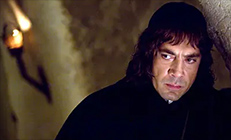
Hands and Tools Twenty-three minutes into the curious Goya’s Ghosts (2006) – Miloš Forman’s final work before dying in 2018 – the film takes leave of the usual ‘artist biopic’ conventions. To this point, the script (by Forman and Luis Buñuel’s collaborator Jean-Claude Carrière) has trod familiar ground – especially familiar to those who know Forman’s highly coherent œuvre: the clashes of Francisco Goya (Stellan Skarsgård) with censorious authorities of the Church (concentrated in the character of Lorenzo played by Javier Bardem); his regular commissions to paint portraits of wealthy aristocrats and royalty (who don’t like the way they look in his depictions); his sentimental attachment (freely invented for the movie) to a young woman (Natalie Portman) who serves as his model, and who will encounter a tragic, historically emblematic destiny. Suddenly, the film departs from presenting the traditional medium of painting – and even from Goya’s interactions with individuals and institutions. We observe, for almost three, detailed minutes, the process of producing one of Goya’s aquatinted, etched prints. Any reader of Carrière’s wonderful 1990s book The Secret Language of Film will recall his encouragement, to writers and filmmakers, to fastidiously research every aspect of their subject – no matter how long a detour it may take them on. The sequence in Goya’s Ghosts largely eschews the faces of the artist and his four busy assistants; we observe the actions of hands and, above all, the effects of the tools prepared and used at each, transformative stage of the proceedings: boiling water, cleansing cloths, and so on. In this series of gestures, the ‘creative flourish’ of the artist himself is decisive, but also merely a link in the chain of a fully technologised operation. In the hindsight of contemporary viewers, the scene is surely meant to recall the stages of photographic creation, at least in its pre-digital form: the successive capturing, developing and treating of an image. In fact, part of the perennial attraction of filmmakers to Goya can probably be explained by the fact that he is seen as a key transitional figure in the history of art and media, poised between painting and photography (and cinematography), and thus a bridge between different worlds. He has even been praised, hyperbolically, as the “original war photographer”. (1) Little wonder, then, that numerous filmmakers – of the calibre of Luis Buñuel, Ulrike Ottinger and Jean-Luc Godard – have been drawn to recreating and animating, in tableau vivant form, certain of Goya’s images. At any rate, this three-minute dive by Goya’s Ghosts into the material process of art – and not the artist’s psychology or his relationships with friends or foes – makes for a refreshing change in the biopic context. Let us now, and for the rest of this essay, explore the implications of such a change within the span of cinema history. As a general rule, whenever biopics concentrate on moments of actual art making, they play up the dramatic, even histrionic quality of emotional projection, artists in a trance-fever of unmediated creativity as they pour their soul onto the canvas. In case you think that is surely a very old-fashioned, Romantic-era conception inadequate to the age of 20th century modern, abstract, and especially conceptual art, just take in the agonies of Nick Nolte as Lionel Dobie as he savagely applies paint-to-huge-canvas, Jackson Pollock-style, to the beat of his favourite rock’n´roll tracks in Martin Scorsese’s “Life Lessons” episode of New York Stories (1989). In that tale, the hip, smarmy, conceptualist performance artist incarnated by Steve Buscemi figures as the villain! I guess Abstract Expressionism, however abstract, is still expressionism – and that’s the hook that biopics generally hang onto, taking it to mean expression of the inner self. Davida Allen’s today little-screened and rather charming semi-feature Feeling Sexy (1999), starring Susie Porter as the artist’s alter ego, follows a similar line, tying the effusions of her painting (what has been called by Lynne Seear her “gestural signature style”) (2) to her erotic fantasy life. But what of the more severe case of Gerhard Richter and his thoroughly conceptual art practice? Just take a peek at Florian Henckel von Donnersmack’s Never Look Away (2018) for a sadly conventional response to that challenge. So, let us refocus on the role of technology, as artist biopics (in general) only rarely or fleetingly do. I intend technology in its widest sense: not just industrially produced machinery, but every kind of tool, support or device that aids in the art making process, from the most humble brush to the most sophisticated computer. The biopic-as-genre can be reframed if we concentrate, as our royal road through the text, on the workings of technology rather the minutiae of a gifted individual’s life. Such an approach tallies with the insights that have recently arisen from the field known as media archaeology, and from the earlier writings of prophetic thinkers including Vilém Flusser: it is the tools that shape the art – and that shape us as its creators – as much, if not more, than it is us who commandeer the tools in order to express our inner visions. Two films that would, at first glance, seem to be far from the milieu of art provide handy, alternative models to the traditional biopic. Both of them depict a historic changeover in technological modes, which is one particularly fertile way to dramatise the role of tools and media. The first, Olivier Assayas’ Sentimental Destinies (2000) adapted from a series of somewhat autobiographical novels by Jacques Chardonne, places its interpersonal drama within the context of changes in the manufacturing industries of the early 20th century – specifically, in this case, the manufacture of porcelain tableware. Essentially, we observe the gradual but revolutionary passage from artisanal to assembly-line production. In many films of this type, the detail of such alterations occurring in factory or workshop would be, at best, a backdrop, sketched in fleeting, representative details as the main characters swiftly promenade through the space. This is especially true in movies about architects and architecture: Intersection (1994), for instance, in which Richard Gere occasionally storms through his workroom of assistants hurling directives or complaints about “fenestrations” and “elevations”. Assayas, to a large extent, upends this typical hierarchy of foreground ‘human interest’ to background historical context. We are asked to pay equal attention – and to care equally – about the evolution of technology and the vicissitudes of intimate and familial relationships. There is a relationship of mutual determination between these factors. The second model is more bizarre, but no less compelling. It is Paul Schrader’s showbiz biopic Auto Focus (2002), based on the rather tawdry life and death of Bob Crane (played by Greg Kinnear), star of the popular TV series Hogan’s Heroes in the 1960s. The film is a veritable study in modern alienation – and this alienation is both the symptom and the effect of a media-driven society. One feels that Schrader, almost perversely, decided to take a greater interest in the changing forms and uses of technology than in the psychology of his characters (drugs and booze play only a secondary role in the decadence depicted). Once again, this alteration of biopic convention is refreshing, albeit unsettling. It was almost inevitable that the meeting of the traditional arts with cinema in the 20th century would raise the issue of changing technology and the transformations it can wreak. At the same moment in late 1940s France that André Malraux was creating collage-like arrangements of fragmented details from great paintings in the layout of his books (thus evoking what he called an “imaginary museum” or “museum without walls”), a young Alain Resnais was experimenting with diverse ways of filming paintings in his shorts Van Gogh (1948), Guernica (1950) and Paul Gauguin (1950): getting in close to small details, using camera movements to create specific itineraries for our gaze, sparingly deploying poetic voice-overs and musical accompaniment as aural counterpoint to the visual realm. The legendary film critic and theorist André Bazin referred to the work of Resnais and others as the “first revolution” to occur in films (essentially, documentary or essayistic films) about art. (3) For Bazin, “this revolution resided in the abolition of the frame, whose disappearance insures that the pictorial universe is at one with the universe tout court”. In other words, the camera – as a prosthetic or bionic extension of the human eye – provided a viewing perspective that was not the usual experience of living spectators seeing these works in a museum. By going right inside a painting, ignoring its frame and its placement within a gallery or museum setting, films offered a new, technologically determined way of seeing and experiencing art works, complete with a “a certain descriptive or dramatic duration”. However, this revolution was limited; Bazin saw it as essentially spatial and not yet truly temporal in nature. The genuine liberation of art by film had not yet occurred. The second revolution, in Bazin’s view, arrived with Henri-Georges Clouzot’s remarkable The Picasso Mystery in 1956. This film, as lively and revelatory today as it was at its Cannes premiere, invents an ingenious intermeshing of Pablo Picasso at work with the machinery of filming: a specially designed transparent screen and lighting arrangement, plus the ability to ultimately flip the screen image’s left and right, allowed Clouzot and cinematographer Claude Renoir to film the artist as he painted – but without having to include or somehow shoot past the figure of the man himself. What we witness (in several variations, also making use of editing ellipses) is the “live” coming-into-being of pictures, all erasures and revisions included. It is an extraordinary record of the process of art making, containing many surprises (such as the way Picasso changes sketched human figures into animals or objects as he goes along). Picasso took the idea of this project to heart so completely that he decided the works produced should exist only in and for the film; he destroyed most of the resulting canvases. As Bazin summed it up, “the canvas exists only as a screen”. Furthermore, the canvas exists only in the evolving stages of its process in movement, not as a fixed, finished work. Long before Roland Barthes wrote his famous (and often misconstrued) “The Death of the Author”, Bazin was sensitive to and excited by The Picasso Mystery’s partial displacement of the figure of Picasso himself as Grand Artist. To use slow motion in order to display the brushstroke technique of an artist (as François Campaux had done in his 1946 documentary Henri Matisse) was not enough; as Bazin suggested, we need to penetrate the material secrets of art making, not the mythology of individual genius. The French-Chilean director Raúl Ruiz may have had Bazin’s analysis in mind, four-and-a-half decades later, when he went so far as to attach a tiny camera directly onto the paintbrush of his friend Jean Miotte – resulting in a merry chaos of abstraction that is, in a new sense, right “inside” the artwork and its evolving process (Miotte vu par Ruiz, 2001). As the avant-garde filmmaker Jonas Mekas commented: “It’s a combat between Miotte and his canvas – like two boxers in the ring”. (4) Intriguingly, The Picasso Mystery ends with a glimpse of Picasso walking off the set – and right past the sculpture he left behind as a gift for the crew, a figure, ambiguously human and/or animal, that is comprised of mocked-up parts of a camera and/or projector. The cinematic apparatus itself has fully become a part of the game of creation. To end this survey on a somewhat more contemporary note, one that anticipates the sequence of Goya’s Ghosts with which I began: I find the most engaging passages of Peter Watkins’ Edvard Munch (1974) to be those that involve close attention to the tools of painting – a fine level of observation matched subsequently in film history only by Maurice Pialat in Van Gogh and Jacques Rivette in La Belle Noiseuse (both 1991). Watkins recreates the first, 1885 version of The Sick Child in the gradual process of Munch progressively scratching and scouring the canvas (using, for instance, the wooden end of his paintbrush), reducing the image to its essential, sketch-like representation and eliminating stray, naturalistic details. Later, as Munch works on Melancholy in 1891, the narrating voice-over (mixed with the harsh sounds of the artist working upon the canvas) states: Seeking a way of peeling down to the essence of the inner reality, of stripping away needless detail and perspective, Munch now combines all the forms of media at his disposal, using pencil, pastel, oil and charcoal – not separately, but together. He applies the oil thinly to permit the canvas texture to remain a visible component of the finished work – to emphasise its flat surface. He allows the preliminary drawings in pencil and pastel, including the corrections made in them, to remain in the final work to show its spontaneity. Watkins’
treatment of the act of painting – simultaneously immersed in
‘live’ detail and distant in its present-day, reflective
vantage-point – is another way to give (as Bazin wished) both
spatial and temporal dynamics to the process of art. NOTES 2. Lynne Seear, “Davida Allen: Survey”, Eyeline, 2004. back 3. André Bazin, “Un film Bergsonien: Le Mystère Picasso”, Cahiers du cinéma, no. 60 (June 1956), pp. 25-28. The translation here is mine, but a complete rendition in English appears in Bert Cardullo (ed.), Bazin at Work (New York: Psychology Press, 2001). back 4. Daniel Rothbart, “Entretien avec Jonas Mekas”, in Dominique Bax & Cyril Béghin (eds), Raúl Ruiz (Bobigny: Le Magic Cinéma, 2003), p. 162 (translation mine). back © Adrian Martin 20 October 2020 |


