|
 |
 |
 |


|
|
|

|
Girls
|
 |
|
Every Other Day
But there is so much more than mere plot information
embedded here. As directed by Lena Dunham (who plays Hannah), the short
sequence is complete ecstasy for any Girls fan. Carefully set to the musical rises and falls, swells and lulls, in a
performance of “Amsterdam” by Gregory Alan Isakov (backed by the Colorado
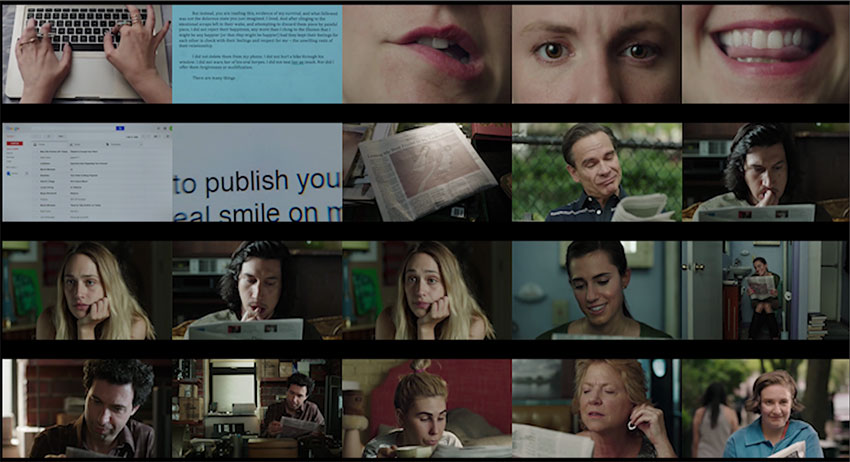
Symphony), the montage begins with fragments of Hannah: her hands typing at her
laptop, her anxious eyes and mouth in separate extreme close-ups, a view of her
email inbox, and then another super close-up of the words of acceptance from a Times editor. Then a leap in time: that
edition of the newspaper now exists, and simply sits on a table somewhere,
where we can read the headline (“Losing My Best Friend to My Ex-Boyfriend”) and
see the accompanying drawn illustration.
Cue a series of dissolves between tightly framed
images of people reading and reacting to the article, all scaled to the same
size and position in the frame, evoking a morphing effect. In this order: Hannah’s
proud Dad, Tad (Peter Scolari); Adam (Adam Driver), the ex-boyfriend in
question, biting his nails, then nearby Jessa (Jemima Kirke), the former best
friend; Marnie (Allison Williams), exclaiming her joy; Ray (Alex Karpovsky) noting
a typo; Shoshanna (Zosia Mamet), a little shocked by the account; and, finally,
Hannah’s mother, Loreen (Becky Ann Baker).
Those central eleven shots contain a wealth of fine,
lovely detail. There is nothing rigidly, grindingly systematic or predictable
about how the roll call proceeds. Father and mother bookend the segment,
separated in the editing – because they are, at this point, separated in their
lives. The tense domestic byplay between Adam and Jessa requires four shots,
because she is simply studying his anxious reaction as he reads, and this
volley introduces the includes the first blast of spoken dialogue into the
episode (“You want to read it?” – “No”). Other characters, in their solitude,
are seen first as a face in close-up, then, further out, within their respective,
domestic settings: Ray picking up a pen to mark the typo he has spotted; Marnie
revealed to be on the toilet, calmly gathering paper to wipe herself.
Everything is expressive of personality: Shoshanna’s musing on “not very
ladylike” behaviour; Loreen’s hard-as-nails reflection on male behaviour, “What
an asshole!”.
And there is yet one, final shot left in the twenty –
the best of all. Its starts on Hannah, blissfully happy, standing stock still
on the street, the city background blurred in the frame; then, as “Amsterdam”
reaches for its grandest, symphonic moment, the camera pulls out, the entire
view comes into focus, and Hannah begins simply walking forward, holding
multiple copies of The New York Times in her arms. To cap it off, and as the music plays on as a transition, there is
the Girls title logo: always
graphically rendered a little differently in each episode, here turned into a
Google Doodle-type arrangement of cartoonish female icons in a row, winking and
moving their limbs in primitive animation.
So much of Girls is encapsulated in these almost-two minutes of image and sound, figure and
performance. (See an audiovisual treatment of the foregoing analysis here.) Grand career dreams nestle up alongside unglamorous, mundane habits; wildly changing
destinies and relationship arrangements duke it out the unchanging bedrock of
personality types; the lingering authoritative aura of “old media” (newspapers)
overlaps with the immediate hipness of online, digital media (email, Google).
As well, the sequence has a special playfulness in its
reference to a classic trope in popular cinema: the grand movie montage of
“everybody” (i.e., a representative string of citizens) reading an
investigative political exposé in the latest newspaper edition and all reacting
in more or less the same shocked and enlightened way (Steven Spielberg’s The Post [2017] offers a typical
example). Girls, by contrast,
foregrounds a different type of journalism (“creative writing”), and emphasises
a wide range of diverse, individualised responses.
Furthermore, this comparison – between a Hollywood
cliché of the “mass” public and Dunham’s knowing portrait of a close-knit
circle of friends and family – provides a decent instruction for how to view Girls as a whole. The series frequently,
even militantly returns us to the unspectacular realm of everyday life; but,
inside that grounded realm, it provides occasions for development, epiphany,
change, even magic.
Intimate Origins
Produced for six seasons between 2012 and 2017, the HBO
TV series Girls was the brainchild of
actor-director-writer-producer Dunham, collaborating with a creative team
including Jenni Konner and Judd Apatow. Think of her in comparison with, for
instance, Orson Welles, who was tagged in his day as a “precocious” talent
while making Citizen Kane (1941) at
the age of 26; Dunham was exactly that same age in 2012. And, like Welles who
had already amassed much work in theatre and radio by the beginning of the
‘40s, Dunham arrived at the centre of mainstream production already quite
experienced and relatively well-known within independent spheres of cinema and
media.
Dunham’s family background is not an insignificant factor
in her creative formation: Dunham’s mother, Laurie Simmons, is a celebrated
photographer who frequently uses dolls in her staged tableaux; and her father,
Carroll Dunham, has been described as an “erotic Pop Artist”. As a student at Ohio’s
Oberlin arts college, Lena combined her evolving skills in photography,
performance art and creative writing – much in the vein of (to take an example
from the previous generation) Miranda July (Me and You and Everyone We Know,
2005). Dunham imbibed the legacies of key figures in American feminist art,
from the experimental filmmaker Carolee Schneemann (famous for boldly erotic
explorations such as Fuses in 1967)
to the photo-artist (and occasional filmmaker) Cindy Sherman, who adopts, in
her images, multiple personae and stereotypes related to available social and
cultural roles for women.
Perhaps most influential on Dunham’s young, anarchic
sensibility, however, was the work made with a toy-like Pixelvision movie
camera by Sadie Benning (daughter of avant-garde filmmaker James Benning) in
the 1990s. Benning’s confrontingly intimate, hyper-close-up portraits of
herself, her friends and immediate surroundings swiftly came to define a “Riot
Grrl” tendency in contemporary art, closely allied with simultaneous
developments in the music scene (where Benning also figured as a member of the
band Le Tigre).
Accordingly, Dunham’s earliest, “home made” pieces
from her early 20s period, such as the 4-minute Pressure (2006), involved the largely plotless performance of
certain “actions”, movements or gestures, or spontaneous interactions with
others. She placed this work (made until 2009) on YouTube, kicking off her
wider public career. Many aspects of her personal and family life are unashamedly
woven into her art practice: her parents, struggle with OCD
(Obsessive-Compulsive Disorder), sexual experiences, bodily states (weight,
food, tattoos, etc). Some of these issues remain but are displaced and
distanced into more elaborately fictional scenarios in Girls.
Dunham progressed from this type of performance art to
the fashioning of off-beat comedy vignettes, and eventually a web series titled Delusional Downtown Divas (2009), an
ongoing satire of the New York art world. Often rough and unpolished, these
skits already signalled what would become a major thematic hallmark of Girls: deliberate awkwardness, in
physical behaviour, speech, and (more generally) in relationships.
After her first attempt at a longer film, Creative Nonfiction (2009), Dunham’s
decisive breakthrough – and the work that led directly to the inception of Girls – was Tiny Furniture (2010), featuring herself alongside Jemima Kirke,
and showcased on DVD (along with a selection of shorter pieces) by Criterion.
In this movie, Dunham draws equal amounts of inspiration from two traditions in
American cinema history: the first is the contemporaneous, loose Mumblecore
movement, in which directors including Joe Swanberg, Lynn Shelton and Andrew
Bujalski concentrated on low-budget, dramatically low-key, character-driven,
primarily dialogue-based pieces, often centred in one or two settings. Many of
the people depicted in the Mumblecore films were slackers (hence the “mumbling”
tag), and their frequently highly sexual relationships were defined by a
certain non-committal irresolution or confusion.
The second tradition – perhaps harder to imagine given
Dunham’s art school beginnings – is the classic screwball romantic comedy of
the 1930s and ‘40s, mixing burlesque humour with a vibrant sense of 20th century relationship neuroses (narcissism, Don Juanism, career temptations) – and
yet with a resolute belief in the hope that love, finally, will find a way, to
unite destined soul mates. All the former Mumblecore affiliates have drifted
(as their budgets have increased) to modern forms of romantic comedy – and
therefore all of them, whether they like it not, exist in the long shadow cast
by Woody Allen over this genre since at least Annie Hall in 1977.
For her part, Dunham takes romantic comedy from its standard 1930s settings of stately homes and country clubs and places it in the heady milieu of rave parties, shared drugs and casual sex relations. Her characters interact within the unspoken rules of a modern, cultural game: people are constantly either confessing their deepest secrets, or daring others to try something outrageous. The family setting in Tiny Furniture is neither homely nor ridiculously luxurious; it is testament to severe, minimalist architecture and design, more akin to a Michelangelo Antonioni drama than a Cary Grant comedy. Accordingly, characters are frequently shown – even when they inhabit the same frame – as alienated, disconnected from each other, divided by walls, glass partitions, domestic obstacles of every kind. Dunham once again hones in, as in her shorts, on intimate, sometimes claustrophobic settings, such as bedrooms and bathrooms.
Since the conclusion of the Girls adventure, Dunham has created (with Jenni Konner) a weak,
swiftly cancelled (after one season) and forgotten comedy series, Camping (2018, remake of a UK show); directed
the first episode of the UK/USA series Industry (2020); and made another feature, Sharp Stick (2022). She has acted small roles in Quentin Tarantino’s Once Upon a Time …
in Hollywood (2019), Jaime Babbit’s The Stand in (2020) and Sia’s Music (2021). Her intriguing book of essays, Not
That Kind of Girl, appeared in 2014.
The Anti-Sex and the City
Deliberately or not, Girls presents itself as an inverted mirror reflection of another
wildly popular HBO TV series, Sex and the
City (6 seasons in 1998-2004, followed by two feature films of 2008 &
2010, and the latter-day sequel series And
Just Like That starting in 2021). Both series focus on a circle of four female
friends, where the central figure is an author pursuing her career through mass
media journalism and book writing; both are set in New York; both provide
glimpses of professions in fields such as public relations, the art world,
filmmaking, and law.
Sex and the City, produced by
Darren Star (of Beverly Hills, 90210 and Melrose Place fame) expertly offered
a grand fantasy of class and luxury – a dream of the good life, peopled by extravagantly
dressed, upwardly mobile professionals. But the series was rarely about the
slog of daily work; it was mainly concerned with the prodigious nightlife of
its heroines. Once again – as in Woody Allen or Mumblecore movies – the longing
for lifelong romance rubbed up against a generous spread of modern neuroses and
resistances, all of them, finally, rather easily overcome.
In Girls,
despite the middle-class family backgrounds of most of its central characters,
the daily economic situation they face is more precarious, and their surroundings
more humble. Travels beyond U.S. shores are portrayed very differently across
the two series: in Sex and the City,
a trip to Paris is a movie-fed wish come true; in Girls, Shoshanna’s attempt to establish herself in Japan brings
only miscommunication and failure. There is also a slight but crucial age
difference at play between the two projects: where Sex and the City’s characters are already mature and independent, Girls (like Tiny Furniture) conjures a liminal or border phase between the realms of girlhood and adulthood: these women often
appear to have stalled in that transitional stage, regressing to childish
tantrums, evasions and games.
Above all, the emotional tone is very different. This
partly reflects a generational change: where Sex and the City was full of urbane, smart talk (another nod to the
1930s screwball comedy tradition), virtually every character in Girls converses at multiple levels of
irony – conveying everything from smugness and superiority to defensiveness and
uncertainty. These young women of the 2010s advance into life, work and
relationships heavily armed with cultural knowingness; they prove themselves so
adept at hiding their true feelings that they are frequently not even sure what
those true feelings are. Hence the characters’ constant register of confusion,
always slipping from one gear to another in any exchange (including the most
intimate) – at one moment suddenly revealing themselves, at another moment
replacing their masks. Everyone is a stranger to others – this is particularly
so when it comes to the relationships between male and female genders in Girls – and also a stranger to
themselves.
Above all else, Sex
and the City was based on the notion that, no matter what difficulties they
may have with each other, the four central women would always reunite and
reaffirm the bond of their collective friendship. This constituted the show’s
vibe of feminist sisterhood. Girls dares to break with this modern, feel-good convention – throughout its six
seasons, the women variously draw together and break apart and, in the end,
appear to drift away from each other definitively, each a satellite on her own
life path. The culmination of this tendency is expressed in the narrative arc
of Season 6: hung on Hannah’s unwilled pregnancy after her affair with a
surfing instructor, the final moments of its last episode show the baby finally
accepting her breast to feed on.
Bodies, Sex and Motion
At the conclusion of Girls’ first season in 2012, Sarinah Masukor wrote a superb essay,
grasping the series in the following way.
Girls is a tremendously physical show. Adam’s irrepressible nakedness,
Jessa’s endless mane of hair and Hannah’s slump-shouldered shuffle transform
the cast from a set of characters into a constellation of hurtling bodies.
There is a trace of the physical cinema of Charlie Chaplin and Buster Keaton in
some of the action. (1)
Such physical states and activities are highly varied
and individualised in Girls. There is
no implicit longing for an ideal body-type for all women (as lingers in Sex and the City, despite its
progressive disclaimers). The series, in its own way, fulfils the dream of
American film critic Manny Farber, who once looked back to the early days of
sound cinema in America and sighed: “In the ‘30s, every shape was legitimate”.
Individual styles of movement are also explored in great depth by Dunham and
her collaborators – as a perusal of the many scenes of dancing (alone, in
pairs, at parties, while intoxicated, or as a choreography of mutual play and
seduction) would swiftly demonstrate.
As Masukor notes, the unusual (for TV) attention to
the physical body in Girls extends to
its frequent depiction of “chaotic, flailing sex. The joining up of limbs […]
is always as triumphant as it is unsure.” (2) The triumph, often, is in the
simple fact that sex is accomplished at all: there are many painfully comic
scenes in Girls involving the
awkwardness of two (or more!) people finding a good, mutually beneficial
position, of fitting into a cramped space, or of more-or-less timing and
managing their respective orgasms.
This well-chosen image of “flailing” brings to mind
the commentary on modern mores by the contemporary philosopher, Mehdi Belhaj Kacem (who played the central role in
Philippe Garrel’s Sauvage innocence [2001]). Although
Dunham’s heroines regularly (as I have indicated) regress into childlike
behaviour, they also
There’s no going back. We go with what we have. Often we’re flailing,
just doing whatever, in the generalised presence of pornography, in the sexual
freedom in our lives. In any case, we can’t go backwards. Solutions like “We
must find the correct balance between the fused couple and debauchery” are just
abstractions, just platitudes. We may as well look for local, temporary
solutions, because this freedom is essential. It’s part of us. (3)
Among the key achievements of Girls, as I have indicated, is the distance it marks between itself
and various cosmeticised, sanitised and reassuring forms of popular
entertainment – especially the many forms of romantic comedy. It is in this
artful discrepancy that Dunham stakes her claim on a certain realism of outlook, tone and style.
In another key early article on the series, American
critic Elaine Blair commented on the relationship “predicament” of Hannah.
[It is] common
enough in life, but it’s not one you see often, if ever, on film. Indeed,
romantic comedy (and its television variations) devotes its energies to
obscuring the possible gaps between things like companionability, attraction, and intense sexual arousal. […] Girls, with its
giddy lightness, its warmth, and its fast-talking, witty, roundly likable
characters, has some of the flavour of romantic comedy while also revealing the
common facts of life that romantic comedy has never been able to show. (4)
Just as Kacem mocked the prospect of ever finding “the
correct balance between the fused couple and debauchery”, Girls arrives at no fixed or secure moral and political conclusion
on the people and behaviours it depicts. Its sixth season swings between the
extremes of “American Bitch” (episode 3), in which Hannah finds herself
engaging in uneasy sexual activity with the older, “toxic” male writer and
celebrity she set out to confront and expose; and the concluding episode, in
which Hannah’s baby (which she did not intend to have) finally warms to her.
A sense of blessed relief here momentarily prevails,
but the mixture of courage and anxiety associated with Hannah’s choice of
single motherhood still hangs in the air; and some undeniable “universals” of
human behaviour are still duking it out with the modern woman’s conviction that
she can constantly remake herself. The wisdom and ingenuity of Dunham’s Girls lies in that always precarious equilibrium.
1. Sarinah Masukor, “On Tenderness”, Transit, 26 July 2012. back
2. Ibid.
3. Olivier Zahm, “Mehdi Belhaj Kacem”, Purple, no. 15 (2011).
4. Elaine Blair, “The Loves of Lena Dunham”, The New York Review of Books, 7 June
2012.
© Adrian Martin September 2018 (with updates) |