|
 |
 |
 |


|
|
|

|
Copenhagen Cowboy
|
 |
|
An
idea that I’m interested to connect with the ambiguity of feelings:
the ambiguity of space. To create a modular house made of different
houses, at times isolated, at times with a view on a beach, very
crowded, or in the suburbs of a big city. The periods also change.
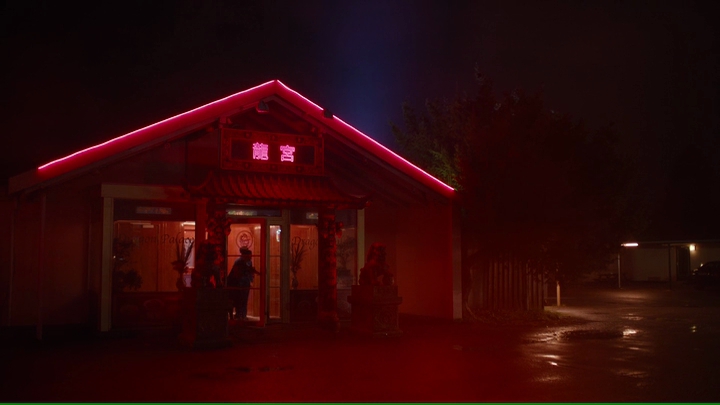
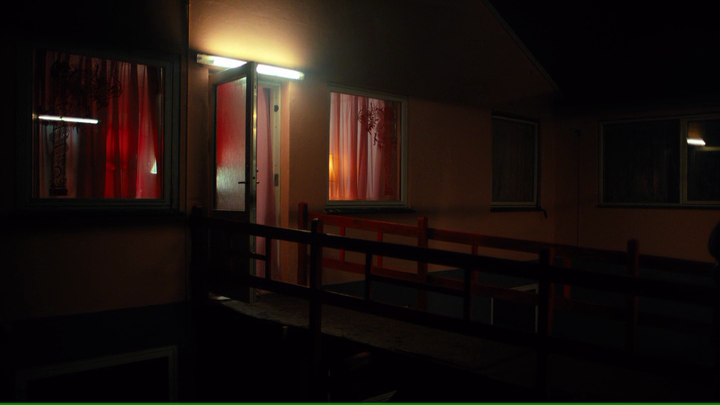
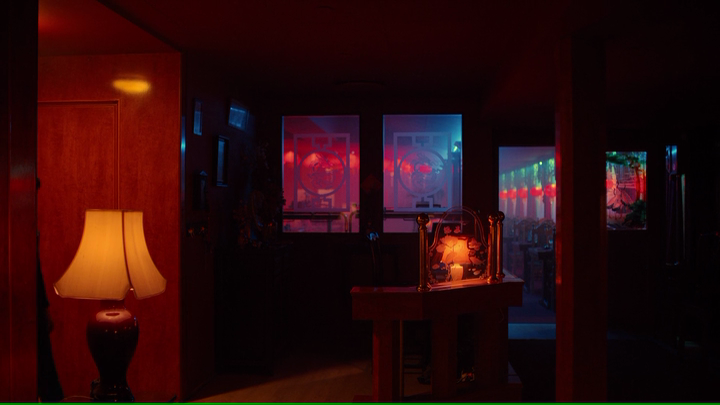
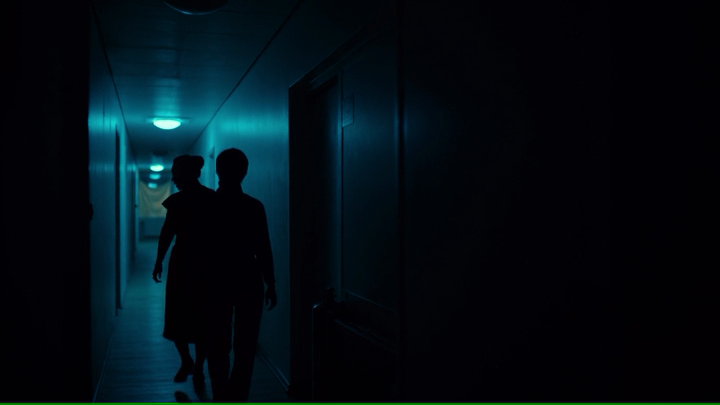
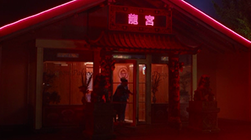
It’s possible that these holidays lasted many years. In the clinical practice of psychoanalysis as proposed by Jacques Lacan and carried through by many of his disciples worldwide, there is a technique that I find unfailingly useful to port over into the study of film and television. It is not the style of ‘close reading’ familiar to many of us in the humanities but, indeed, almost the exact opposite. Variously tagged as “evenly suspended attention”, “listening for the unconscious” or “listening to the letter”, the technique refers to the way the analyst tries to take in everything at once: not just the content of the words uttered by a patient on the couch, but the tone, the style, the phrasing – the materiality and (oftentimes) the strangeness of performed speech. However, this does not necessarily imply a strenuous mode of attentiveness on the analyst’s part; even more crucially, it can involve a certain degree of ‘tuning out’, of deliberately not following the plot of the patient’s speech. I have heard this approach described by a Lacanian practitioner as listening off. It is only in that state of evenly suspended listening/observing that the genuinely fascinating tics and obsessions at play may rise to the surface and become evident. And this is, as it happens, exactly how I like to watch the work of Nicolas Winding Refn. Let’s see what such a séance can bring to the table. (2) Refn has long been fond of huge, cavernous spaces: warehouses, diners, hangars, bowling alleys, open plan offices, farm sheds. In Copenhagen Cowboy, his second shot at a TV series after Too Old to Die Young (2019), a striking touch is added to this predilection: the evident discrepancy between how modestly scaled certain places may appear according to their front, exterior façade, and the seemingly limitless area they cover whenever the camera is inside them. Interior
spaces are revealed, or rather unfolded, according to a particular
visual logic of découpage in Copenhagen Cowboy.
The Dragon Palace restaurant, introduced midway through episode 2,
provides the most flagrant example. Its front, like its back,
indicates a place scarcely bigger than those of an average, suburban
home.
It is a common practice in filmmaking that facades and interiors may rarely belong together in reality. The establishing shot of an actually existing building, for example, is often combined with views enabled by a built studio set. Conventionally, however, as much as possible is done to provide an illusion of seamlessness, cohesiveness and coherence (or suture, to use the film theory term) between these constituent parts of the same diegetic location. Refn, however, is after something entirely different: he counts on an unstated but constant, niggling feeling of hallucinatory or dreamlike physicality. The properties of space and time become elastic, as do the normal cause-and-effect relations of actions occurring within their framework. The closest comparison, on this level, would be what Raúl Ruiz achieved in his fantastique piece Nucingen House (2008). Now let us turn to an instance of a different type of manipulation of space in the House of Refn – a designation I am coining because of the unmistakable affinity between the director’s by now instantly recognisable branding of his style, and the type of manufacturing logic that governs the market dissemination of fashion, perfume or accessory labels. (Little surprise that Refn’s subsequent job was the 28-minute short Touch of Crude [premiered 2022, released 2023] for Prada.) Episode 5 of Copenhagen Cowboy contains a tour de force of action filmmaking à la Refn. In this sequence, the central character, Miu (Angela Bundalovic), meets with Danny (Ebiriama Jaiteh), a contact within the drug dealing trade, in a public area – high-rise apartment buildings are lit-up everywhere in the background. “This is a fucking war!”, Danny melodramatically declares – variations on this statement are delivered repeatedly – but the action that then plays out is paradoxically characterised by stasis, silence, depopulated spaces and obscured visibility. The motions and gestures of violence that eventually intervene are rendered in long shot and slow motion (Miu runs out of the frame to fell opponents whose faces are cloaked in darkness), and the initial gunshot suffered by Danny is heard by her from off-screen. A succession of incoming warriors is shot by Danny – each kill necessitating a turn of his body and a carefully choreographed alteration in the direction of his and Miu’s screen-looks. She waits impassively for Danny to entirely expire from his fatal wounds, and then calmly walks away with the disputed bag of drugs. Refn cuts to one of the many stylised montage sequences that punctuate the series: firing guns alternate with figures (one of whom wears a clown mask) falling out of frame, all once again in slo-mo. And that’s it for the representation of a “war” that has supposedly seized the entire city! This sequence recalls the similarly daring and prolonged car chase in episode 5 of Too Old to Die Young – which is mainly just one vehicle trailing another in a vast, open landscape. I have so far mentioned nothing about the subject matter or story of Copenhagen Cowboy. That is because the form or shape of the story, as is increasingly the case in Refn, is more important than its content. At first glance, Copenhagen Cowboy is a basic revenge tale in the vein of Quentin Tarantino. Refn, however, is finally not terribly interested in the moral or ethical questions arising from revenge plots – the sort of thematic complication to which Tarantino pays lip service. Ultimately, such retribution matters as little to Refn as the orientalist signifiers sprayed everywhere, the Gothic sexual scenarios of human trafficking, jokes about the almighty (and endangered) penis, the drama of hidden family connections (vaguely reminiscent of Josef von Sternberg’s The Shanghai Gesture [1942]), or even the heavily laid-on element of vampirism. These often cheekily loaded items of content serve mainly as pretexts for his style – so one should be wary of interpreting them too symptomatically. The type or mode of narrative chosen here is deliberately simpler and sparer than the “mobile suspension” (3) and complicated interlocking of diverse threads in Too Old to Die Young. The scope of events, while culminating in a final gesture of sudden escalation (the gang war set to become fiercer), falls far short of the millennialist obsession with social and cosmic apocalypse laid out in Too Old to Die Young. (4) Furthermore, Copenhagen Cowboy is, for the most part, focalised on the trajectory of a single, main character: Miu. As spectators, we mainly discover people, places and conditions at the same rhythm and in the same way as she does. On the other hand, Refn has allowed more playfulness and collaboration into the scripting process of Copenhagen Cowboy, using what he referred to as a “writers’ room” (a staple of television production) comprising Sara Isabella Jönsson, Johanne Algren and Mona Masri. As a result, there is an open, speculative quality arising irresistibly from certain details. My personal favourite among these touches is Miu’s disarming declaration in episode 2 that she was once “kidnapped by aliens” – a line scarcely commented on or expanded upon during the season (except maybe for a stray fallen spaceship?), thus leaving us to wonder whether it is a crucial backstory clue or simply an ironic, misleading joke. Copenhagen Cowboy’s narrative runs on a strict economy of monetary debt – and how the accounting of that economy can so easily be derailed. This logic counts more than any moral issue potentially involved. The moment in episode 1 that Rosella (Dragana Milutinović) refuses to pay Miu the amount that was promised is a clear sign that her house (and every bad person in it) will be burned to the ground; later in the series, the fact that Chiang keeps stretching out the obligation visited on Miu – to perform acts in return for the eventual release of little Ai (Emilie Xin Tong Han) – ensures his demise. Refn has become the most relentlessly parametrical filmmaker of the 21st century. By this I mean (après David Bordwell) that, whatever the scene or situation, he imposes the same battery of stylistic devices – and he intends them to be noticed by the viewer (this quality of the insistent obviousness of formal choices is what Bordwell calls parametric narration). (5) Most notable among these devices are: the slow panning movement of the camera (necessitating sometimes ingenious engineering of the actors into and out of the mobile frame); long takes with the camera in a static position; the relentlessly garish lighting and colour scheme of reds, blues, greens and yellows; the steady tic-tic-tic of the synth music soundtrack (here credited to four composers); and the strictly choreographed stasis of the actors, with their spoken lines punctuated (or entirely replaced) by gaping silences. And all this in service of the slowest slow burn of the long-form, large-scale intrigue – an aspect of the TV medium that Refn really seems to embrace and enjoy. This ensemble of coordinated techniques is impressive enough in a World Art Cinema or film festival context; on TV (whether broadcast or streamed), the procedure is (and is bound to remain for a long time to come) utterly startling, foreign to almost anything else happening in this medium. A counter-example would be David Lynch’s Twin Peaks: The Return (2017). It certainly goes way out on a televisual limb aesthetically – but Lynch tends to tackle each sequence in an individual way, giving each one a slightly different, distinctive style or manner. Parametrics is, quite simply, not a game that Lynch plays. Refn, on the other hand, takes the game so far that there is not merely a diachronic structure of comparison of all the different moments where a particular technique is used; there is even a synchronic treat at the beginning of episode 5, when he layers (as in an art gallery installation) two distinct widescreen panorama shots, travelling in different directions, on top of each other. One special aspect of Refn’s refined excess (if such an oxymoron is permitted) is his approach to casting. Actors are not only cast for or against type in relation to their given screen personae (i.e., the types of situations and psychologies their presence suggests); Refn always zeroes in, unerringly and at times perversely, on the sheer physicality of his performers – but not necessarily to foreground that feature of their being. A remarkable example of this came to me while using the Lacanian off-watching trick on The Neon Demon (2016). Christina Hendricks is an actor whose voluptuous figure was (in various ways and on various levels) made a centre of attraction in the TV series Mad Men (2007-2015). Refn, it seems to me, took Hendricks and deliberately staged and framed her so as not to make the proportions of her body into a spectacle – to play totally against that expectation. If you re-look at her scenes with this principle in mind, I promise you will be amazed at the dexterity and inventiveness of Refn’s constantly strategic corporeal erasure of Hendricks in this regard. In Copenhagen Cowboy, Refn takes a related, recent trend and makes it indelibly his own. It is the process I think of as face casting in contemporary television – in the double sense of hiring an actor primarily because of their facial features, and then also fixing that face, setting it rigid as if in a mould within the overall mise en scène. (6) Current popular, audiovisual culture is marked by these faces that are stony, inexpressive, and yet – precisely because of that rigidity – suggestive of psychosis or sociopathy (or, less sensationally, autism). Prime examples include Jodie Comer in Killing Eve (2018-2022) and Anya-Taylor Joy in The Queen’s Gambit (2020) – not to mention the entire principal cast of Alex Garland’s Devs (2020). Need it be said that Angela Bundalovic as Miu is the most extreme instance of this trend imaginable? But most actors in Copenhagen Cowboy fit this bill, such as Zlatko Burić (a Refn regular) in the role of Miroslav. More generally, faces in Copenhagen Cowboy are treated in exactly the way Sternberg frequently advised they should be deployed: as a part of the décor, as a surface that can be dressed, altered, shaded, painted. Hence not only the various dream or visionary apparitions of Miu’s face adorned with various objects and patterns, but also the stylish mask that adorns the hideously eaten-away countenance of Niklas (Andreas Lykke Jørgensen). In Refn – and especially in Copenhagen Cowboy – physical gestures tend to become detached from the characters who are seen performing them. An appropriate state of watching-off reveals, for example, an emphasis, beyond all conventional purposes of signification, on swift, beckoning hand gestures that involve the fingers (moved or clicked) and the palm: Miu, Mr. Chiang (Jason Hendil-Forssell), and others all do them, interchangeably. This is the residue of the crisp, cool, fanatically precise gestures found in the movies of Jean-Pierre Melville, who wielded such an enduring influence over Refn’s Drive (2011). Likewise, one can trace a deliriously absurdist pattern of various characters negotiating a veritable obstacle course comprised of repeated sitting and standing motions – reminiscent of the cruel parade of blocked or awkward movements in the cinema and theatre of Carmelo Bene. (7) Refn’s fans like to joke, a little defensively, that this auteur may perversely enjoy creating series – and, in the process, building elaborate fictional worlds – that are destined to dissolve at their cliffhanging peak, never allowed (as yet, at least) to proceed to a second season. It’s another, post-post-modernist form of mobile suspension, and one with a galling frustration factor built in. (A similar feeling of imminent disappointment shadows Gregg Araki’s outrageous one-seasoner for Starz, Now Apocalypse [2019].) This level of mismatch between Refn’s art and the TV-streaming industry of today strengthens my watching-off conviction that the generic templates (such as the revenge narrative) chosen by Refn to mess with ultimately serve a purpose beyond themselves. Refn’s
proudly excessive style is not (as it may sometimes seem)
fundamentally disconnected from his content; rather, the pro-filmic
situations themselves, like the locations, are devised and shaped in
order to allow his preferred stylistic moves to take place. The tiresome cliché wheeled out in criticism of Refn,
Ruiz, and dozens of other significant filmmakers – that their work
is “all style and no substance” – can quickly be defused by a
viewing of Copenhagen Cowboy:
style is the substance, and Refn is sticking to it, come what may. 1. Raúl Ruiz (trans. Catherine Petit & Paul Buck), Notes, Recollections and Sequences of Things Seen (Paris: Dis Voir, 2022), p. 67. This book is a selection, chosen by Érik Bullot and Bruno Cuneo, from Ruiz’s much larger Diario (Santiago: Ediciones Universidad Diego Portales, 2017); in its original Spanish, the passage appears on p. 103 of Volume II. back 2. In his book on Stanley Kubrick’s Eyes Wide Shut (London: British Film Institute, 1999), Michel Chion also advocates (without explicitly citing Lacan) what he calls a non-intentional method of film analysis. “The right way to work on a film – to avoid too closed an interpretation – seems to me to be to watch it several times with no precise intentions. […] A film is a system, not of meanings, but of signifiers. We must go in search of these signifiers […] and we can do this only by means of a non-intentional method; for in cinema, that art that fixes rhythms, substances, forms, figures and all kinds of other things onto a single support, the signifier can sit anywhere” (pp. 37-38). back 3. I derive this suggestive term from Jean Narboni’s contribution to the collective text “Montage” that originally appeared in Cahiers du cinéma (no. 210, March 1969), and is accessible in Tom Milne’s English translation at: <http://www.dvdbeaver.com/rivette/ok/montage.html>. back 4. For a useful account of this sensibility across many contemporary cultural phenomena, see Ashley Crawford, Religious Imaging in Millennialist America: Dark Gnosis (London: Palgrave Macmillan, 2018). back 5. Bordwell’s initial exposition of this concept appeared in Narration in the Fiction Film (London: Routledge, 1987). It has subsequently been refined in many entries on his & Kristin Thompson’s blog Observations on Film Art, <https://www.davidbordwell.net/blog/>. David sadly passed away at the age of 76, a year after I wrote this essay. back 6. For more on this phenomenon, see my “World Wide Angle (Redux): Gasten op gezicht”, FK_XL (Special 40th Anniversary Edition of de Filmkrant), November 2021, pp. 26-27. back 7. See my chapter “Carmelo Bene, the Agitator” in Rossella Catanese & Jennifer Malvezzi (eds), Italian Experimental Cinema and Moving-Image Art: New Paths, New Perspectives (London: Palgrave Macmillan, 2025). back © Adrian Martin March 2023 |